Artivorin Official Website › Blog › Best Joint Supplement 2026
Best Joint Supplement 2026: 7 Checks to Use Instead of a Ranking
Lists that crown a number one joint supplement rarely show their working. This post shows its working instead, with seven checks that any shopper can run on any bottle in five minutes.
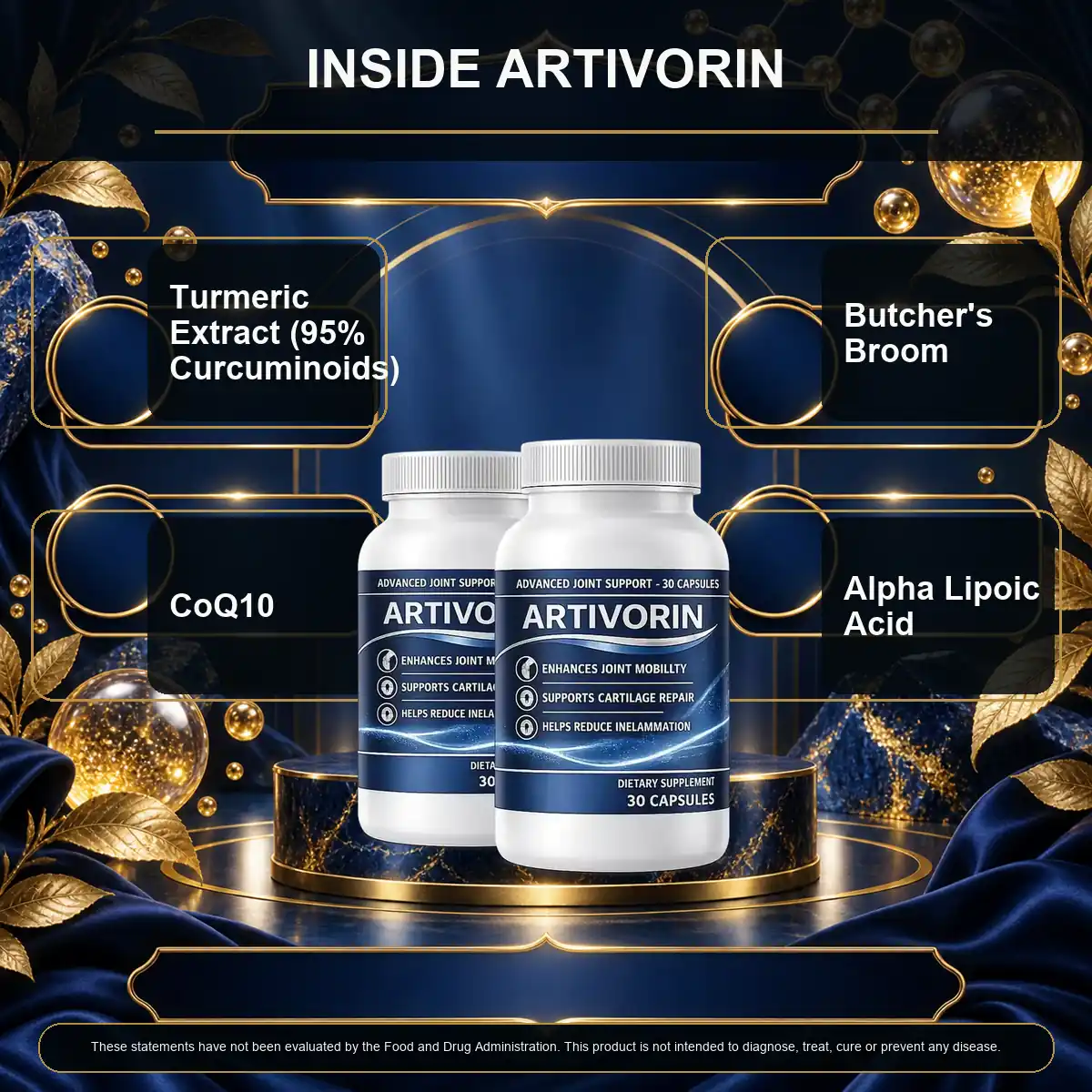
This post names no best joint supplement, because a fair ranking needs printed amounts and head-to-head trials that most labels do not give. Use seven checks instead: named ingredients, printed weights, matching grade, research-range amounts, an absorption partner, trials in joints, and a way to return it. Artivorin passes some and fails others.
- Most joint products are built from about ten ingredient families, mixed in different proportions.
- The 2019 rheumatology guideline puts exercise and weight management first, and names only one supplement.
- A 2025 network meta-analysis of 39 trials and 4,599 patients ranked Boswellia first for pain and stiffness among seven supplements.
- Curcuminoid trials in knee osteoarthritis used 1,500 mg a day. A label with no weight cannot be compared with that.
- This site sells Artivorin. It is not an independent ranking.
- Artivorin scores two clear passes, three outright failures, and one check that cannot be answered, among eight.
Check 1: Why can this post not name a number one?
A fair ranking needs three things: printed amounts, the same condition studied for each ingredient, and trials that compare products head to head. Most joint supplements offer none of them.
The best evidence is split between two documents. A clinical guideline says what doctors should recommend. A network meta-analysis compares what has been measured. They do not conflict. A supplement can show a small, steady effect in trials and still fall short of a guideline's bar.
This site sells Artivorin, so it has an interest. That is why it shows a method instead of a verdict, and why it names no other brand. Use the method on any bottle, including ours.
Check 2: Are the ingredients named one by one, with a weight beside each?
Turn the bottle over. A named ingredient with a weight can be compared with research in seconds. A blend line gives one weight for a group, and a group weight can hide an unequal split.
Names without weights cannot be checked, compared between products or reasoned about by anyone outside the factory. This is the check that decides whether the rest of a label is information or decoration.
Most shelves fail here, because a proprietary blend is still common. A fail here also makes the amount check and the absorption check hard to run.
Check 3: Does the grade match what the trials used?
An extract is not the food it came from, and two extracts of one plant can differ a great deal. A figure like 95% curcuminoids names the grade, and the knee trials used that grade.
Look for the part of the plant too. Nettle root and nettle leaf are different ingredients. Butcher's broom research sits under the root, with the standard combination using 150 mg of root extract per capsule. A label that names only the plant leaves out the detail that decides whether the research applies.
Check 4: Is the amount inside the range the research used?
This is arithmetic, once a weight is printed. Watch for percentages. Ten milligrams of a 5% extract is half a milligram of the active compound.
| Ingredient | Amount used in the research | Where it comes from |
|---|---|---|
| Curcuminoids | 1,500 mg a day, in three divided doses, over six weeks | The 2014 knee trial, and the same daily amount in a 367-patient study |
| Turmeric extract, whole | 2 g a day | An earlier pilot against ibuprofen |
| Coenzyme Q10 | 300 to 400 mg a day, strongest effect on inflammatory markers | A dose-response review. Not a joint trial |
| Alpha lipoic acid | 600 mg a day | SYDNEY 2 and NATHAN 1, both in diabetic nerve damage |
| Butcher's broom | 150 mg of root extract per capsule | The ruscus combination review. Venous, not joint |
| Glucosamine sulphate | 1,500 mg a day, by convention | Decades of trials with contested results |
| Chondroitin sulphate | 800 to 1,200 mg a day | Usually alongside glucosamine |
Research amounts, not label amounts. Do not read them as a dose to take.
Check 5: Is an absorption partner named where one is needed?
Curcumin is the case that matters. On its own it absorbs poorly. The 1998 piperine study found human blood levels undetectable or very low after 2 g of curcumin alone, and sharply higher with 20 mg of piperine beside it.
Research formulas use piperine, a phospholipid complex or a nanoparticle system for this reason. A turmeric label with none of these has left the biggest variable in its own story unstated. Something may be inside and simply not printed, which is no better.
Check 6: Do trials exist for the condition on the front of the bottle?
An ingredient can be well studied and unstudied in joints at once. Trials are run in conditions, not in ingredients. Alpha lipoic acid has two of the longest supplement trials ever run, both in diabetic nerve damage. Butcher's broom has a 166-patient trial, measuring leg volume.
In the 2025 comparison of seven supplements, Boswellia ranked highest for pain and stiffness. Curcumin, collagen, ginger and krill oil showed benefit on some outcomes. No supplement was linked to more adverse events than placebo.
The guideline names one supplement in its recommendations: chondroitin sulphate, conditionally, for hand osteoarthritis. Its strong advice is exercise and weight management for people who are overweight.
Check 7: Can you send it back, and do the seals name anyone?
A seal is a claim like any other. A GMP mark with no certifying body named cannot be looked up. A registration roundel with no number cannot either. A return policy with a phone number and a stated number of days is worth more than a badge.
Price is a fair last filter. This site's own pricing page lists category costs in rough monthly terms: a standardised curcumin capsule with a printed weight at $15 to $40, glucosamine and chondroitin at $10 to $30, and a Boswellia extract at $20 to $35.
| Check on Artivorin | Result |
|---|---|
| Ingredients named one by one | Pass. Four names, no blend |
| A weight beside every active | Fail. No weight printed |
| Species and plant part named | Fail |
| Grade matches the trials | Pass. 95% curcuminoids |
| Amount in the researched range | Cannot be answered, because no weight is printed |
| Absorption partner named | Fail. None among the four |
| Trials in the condition on the bottle | Partial. One of four |
| Seals name someone and a refund exists | Split. Seals name nobody, refund route is strong |
From this site's own eight-check scorecard. A product that passed all eight would be rare.
Frequently asked questions
What is the best joint supplement in 2026?
This post names none. A fair ranking needs printed amounts and head-to-head trials, which most labels lack. Use the seven checks on any bottle instead.
Is there a number one joint supplement?
Not one that can be proved from published evidence. The 2025 network meta-analysis ranked Boswellia highest for pain and stiffness among seven supplements, but that compares ingredients, not brands.
What should I look for on a joint supplement label?
Individually named ingredients, a printed weight beside each, a named grade or plant part, an amount near the research range, an absorption partner for curcumin, and a return policy.
Do joint supplements work?
The evidence is mixed and modest. The rheumatology guideline puts exercise and weight management first and names one supplement. Some ingredients show small benefits in trials.
Are joint supplements safe?
In the 2025 comparison, no supplement was linked to more adverse events than placebo. Specific cautions exist, such as curcumin with blood thinners and alpha lipoic acid with blood sugar.
How does Artivorin score on these checks?
Two clear passes, three outright failures, one partial, one split, and one check that cannot be answered, among eight. The weak spot is that no weight is printed.
Our view
Our view: the best joint supplement for you is the one whose label lets you check it and whose seller lets you return it. On the first count Artivorin is weak, and on the second it is strong.
If printed amounts matter most to you, choose a single-ingredient product with a weight on the label. If a named retailer and a 60-day window matter more, Artivorin is worth a measured test.
Safety note. These statements have not been evaluated by the Food and Drug Administration. This product is not intended to diagnose, treat, cure or prevent any disease. Artivorin is a dietary supplement. It is not FDA approved, and no supplement is. Ask a doctor about any health question.
Last updated
Sources named on this website
- The American College of Rheumatology's osteoarthritis guideline
- The 2025 network meta-analysis of seven supplements
- The 2014 curcuminoid knee trial
- The 1998 piperine pharmacokinetic study
- The meta-analysis of the ruscus combination
- The SYDNEY 2 trial
- NCCIH's guidance on using supplements wisely
- The NIH Office of Dietary Supplements