Artivorin Official Website › Choosing a supplement
Choosing a supplementChoosing A Joint Supplement: Eight Checks
Eight questions answerable from a label and a website in about five minutes.
Are the ingredients named individually, is a weight printed beside each, is the plant part named, does the material match what was tested, does the weight land inside the researched range, is an absorption partner named, is there trial evidence in this particular condition, and can the purchase be undone by telephone.
Eight questions that work on any label in any shop, run at the end against the bottle this website sells.
The eight checks
Eight questions, answerable from a label and a website in about five minutes.
1. Are the ingredients named individually, rather than as a blend?
A blend line gives one weight for a group, and a group weight cannot be set against anything the research did. It fixes an upper bound and leaves the distribution unknown: the name at the top of a six-ingredient blend may be carrying almost the entire figure, or almost none of it. Individual names are the foundation every check below is built on.
2. Is a weight printed beside every active?
This is the check that decides whether the rest of the label is information or decoration. Names without weights cannot be checked against research, cannot be compared between products, and cannot be reasoned about by anybody outside the factory.
3. Is the species and the plant part named?
Nettle root and nettle leaf are two different ingredients. So are butcher’s broom rhizome and its aerial parts, and turmeric rhizome and turmeric leaf. The research almost always sits under one part, and a label naming only the plant has left out the detail that decides whether the research applies.
4. Does the material match what the trials ran on?
Concentrated extracts and whole dried plant behave differently, and two extracts of the same species can differ from each other by a factor of twenty. A standardisation figure — 95 per cent curcuminoids, say — names the grade and is worth real credit. Where a trial used the raw material and a bottle carries a concentrate, or the reverse, the trial is about something else.
5. Does the amount sit in the range the trials used?
Arithmetic, once check two passes. Curcuminoid research ran at 1,500 mg a day. Watch percentages: 10 mg of a 5 per cent extract is half a milligram of the active compound, and a great many labels rely on nobody dividing.
6. Where an ingredient needs an absorption partner, is one named?
Curcumin is the case that matters. On its own it absorbs poorly, which is why research formulations pair it with piperine or a phospholipid system. A turmeric label naming no enhancer has left the largest variable in its own story unstated.
7. Do the ingredients have trials in the condition the label names?
An ingredient can be thoroughly studied and completely unstudied in joints, because trials are run in conditions rather than in ingredients. Check each name against the condition on the front of the bottle, not against its general reputation.
8. Do the seals name anybody, and is there a refund route with a telephone number?
A GMP mark that names no certifying body cannot be looked up. A registration roundel with no number cannot be looked up either. And a return policy with a telephone number, an address and a stated number of days is worth more than any badge on the pack.
The scorecard applied to Artivorin
Eight checks run on the bottle this website sells, with the failures printed first in the note.
This site sells the product being scored, and running the checklist on it is the only thing that makes the checklist worth reading. Here is what the eight checks produce.
| The check | Result | Why |
|---|---|---|
| 1. Ingredients named individually | Pass | Four names, in the same order, on the seller’s pack sheet and on both of its ingredient graphics. Three independent sources agree, and no proprietary blend appears anywhere. |
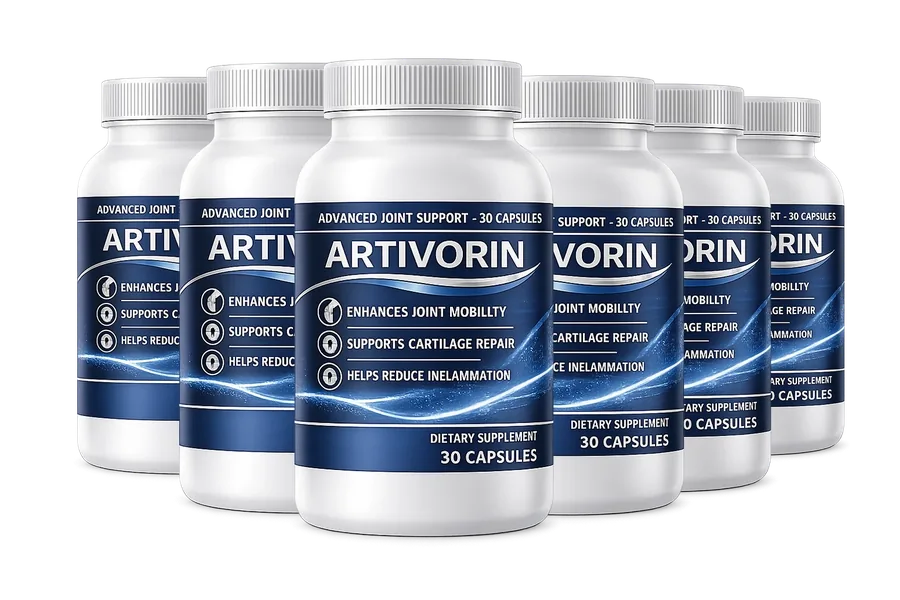
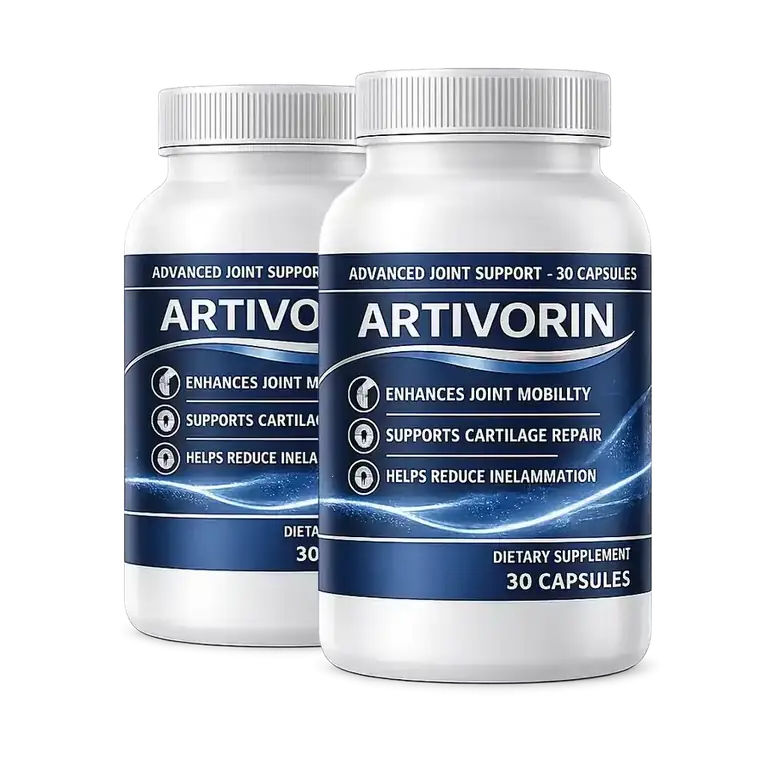
| 2. A weight beside every active | Fail | No milligram figure appears against any of the four, on either of this product’s two websites. No Supplement Facts panel exists in the published artwork, and every product photograph is a front three-quarter view. |
| 3. Species and plant part named | Fail | Turmeric extract is named without the part, and butcher’s broom without either the Latin name or the part. For that ingredient the part decides everything: the trial record sits under the rhizome. |
| 4. Material matches what the trials ran on | Pass | 95 per cent curcuminoids is the research grade, and it is the material the randomised knee trials used. Naming it is more than a good deal of this category manages. |
| 5. Amount inside the researched range | Cannot be answered | Check two failed, so this one cannot be run. The research amount is 1,500 mg a day of curcuminoids; what is in this capsule is not knowable from anything the seller has published. |
| 6. Absorption partner named where needed | Fail | No piperine, phospholipid complex or nanoparticle system appears among the four ingredients. Something may be present and unprinted; a buyer cannot tell. |
| 7. Trials in the condition on the front of the bottle | Partial | One of four. Curcumin has 30 randomised trials in osteoarthritis. CoQ10, alpha-lipoic acid and butcher’s broom have none, and their own trial records are in muscle, nerve and vein respectively. |
| 8. Seals name somebody, and a refund route exists | Split | The GMP mark names no certifying body and the FDA roundel no registration number, so neither can be looked up. The refund route is the strongest thing on the pack: sixty days, a telephone number, +1 (323) 347-4522, and a New York returns address. |
Two clear passes, one partial, one split, three outright failures and one check that cannot be run because an earlier one failed. Scored against the label artwork, the seller's published pages and the trial record cited at the foot of this page.
A product that passed all eight would be a rare thing, and a checklist whose author’s own product passed all eight would not be a checklist. What matters is which checks failed and how much they cost.
Here, the expensive failure is check two, because check five depends on it. The one ingredient on this label with a serious joint evidence base is the one whose amount cannot be established, which means the best argument for the product is also the argument nobody can verify.
The failures, in detail
Four rows examined properly, because a fail without a reason is just an assertion.
Three outright failures and one that could not be run. Each is worth a paragraph, because a fail in a table is an assertion and a fail with a reason is information.
Check two: no weight beside any active
Every image published for this product was opened, including the sister domain’s differently illustrated ingredient graphic. Both are headed with the same phrase, both name the same four ingredients in four framed boxes, and neither carries a milligram figure, a serving size, a servings-per-container line, a percentage daily value column or an other-ingredients line.
This is the failure that produces two of the others. Without weights, check five cannot be run and check six cannot be assessed properly either.
Check three: no plant part for butcher’s broom
The whole clinical record of Ruscus aculeatus sits under the underground rhizome and root. The meta-analysis of the standard combination describes capsules of 150 mg of root extract. A label naming only the common name has left out the part that decides whether any of that applies.
The same criticism applies more mildly to the turmeric row, where the standardisation figure at least establishes what the material is.
Check six: no absorption partner named
The 1998 pharmacokinetic study found human serum curcumin undetectable or very low after 2 g on its own, and sharply higher with 20 mg of piperine alongside. Modern trial formulations solve this deliberately.
Nothing among the four named ingredients is an established curcuminoid enhancer. Something may be in the capsule and simply unprinted, which is the same answer as check two and is not a better one.
Check five: unanswerable rather than failed
It is scored separately because the distinction matters. This is not a product that prints a weight below the research range; it is a product that prints no weight, so the comparison every other page on this site would like to make is structurally unavailable.
That is worse than a low number in one respect and better in another. A low number would at least be checkable.
The passes, which are also worth reading
Three and a half checks in this label’s favour, each one real.
A scorecard that only produced criticism would be as useless as one that only produced ticks. Two checks pass outright and half of a third does, and each of them is a real point in this label’s favour.
- Check one. Four ingredients, named individually, with no proprietary blend anywhere. A great deal of this category still hides behind a single blend total, and this label does not.
- Check one, the second half. The same four names appear in the same order in three independent places: the seller’s pack sheet, this domain’s ingredient graphic and the sister domain’s. Three sources agreeing on a list is unusual enough in this category to be worth saying out loud.
- Check four. 95 per cent curcuminoids is the research grade, and it is the material the randomised knee trials were run on. A bottle saying only turmeric could be holding kitchen spice.
- Check eight, the refund half. Sixty days from purchase, on an opened bottle, with a telephone number and a New York returns address published on every page. That is a stronger commitment than most of this category offers and it is the one mark on the pack with a named party behind it.
Put together, the passes describe a label that tells you what is in the bottle and backs the purchase, and the failures describe a label that will not tell you how much. Whether that trade is acceptable is a genuine decision rather than a rhetorical one, and it depends entirely on whether you are the kind of buyer who reads panels.
Taking the eight checks to any other bottle
Two predictions about what any shelf will produce, and the five-minute version.
The list is worth more applied to a shelf than applied to one product, and two predictions are worth making before you start.
Most products fail check two, because a proprietary blend is still the industry default and a blend total is not a weight. A failure there collapses checks five and six with it, which is why it is the first question to ask.
The second commonest failure is check three. A panel reading nettle extract, ginger extract or butcher’s broom without naming a part has left out the detail the research turns on, and it is usually a sign that nobody in the supply chain was asked the question.
Where a label passes all eight, the price is usually higher and the ingredient list shorter. That is not a coincidence: printing weights invites the comparison, and a company that invites it tends to have arranged the numbers to survive it.
- Turn it over. Is there a panel with numbers on it, or a blend total?
- Pick the ingredient the front of the bottle is selling. Is there a weight beside it?
- Is a plant part named, or just a plant?
- Does the weight look like the research amount, after dividing by any percentage?
- Is there a telephone number and a return window anywhere on the packaging or the website?
Sources behind these eight checks
The research amounts each check is measured against, confirmed by a live call to the National Library of Medicine.
- Panahi Y, Rahimnia AR, Sharafi M, et al. Curcuminoid treatment for knee osteoarthritis: a randomized double-blind placebo-controlled trial. Phytother Res. 2014;28(11):1625-31. PMID 24853120. Dose: 1,500 mg/day of curcuminoids in three divided doses for 6 weeks. https://pubmed.ncbi.nlm.nih.gov/24853120/
- Kuptniratsaikul V, Dajpratham P, Taechaarpornkul W, et al. Efficacy and safety of Curcuma domestica extracts compared with ibuprofen in patients with knee osteoarthritis: a multicenter study. Clin Interv Aging. 2014;9:451-8. PMID 24672232. Dose: 1,500 mg/day of Curcuma domestica extract against ibuprofen 1,200 mg/day for 4 weeks. https://pubmed.ncbi.nlm.nih.gov/24672232/
- Shoba G, Joy D, Joseph T, et al. Influence of piperine on the pharmacokinetics of curcumin in animals and human volunteers. Planta Med. 1998;64(4):353-6. PMID 9619120. After 2 g of curcumin alone, human serum levels were undetectable or very low; 20 mg of piperine alongside it raised them sharply. https://pubmed.ncbi.nlm.nih.gov/9619120/
- Zhang Y, Gui Y, Adams R, et al. Comparative effectiveness of nutritional supplements in the treatment of knee osteoarthritis: a network meta-analysis. Nutrients. 2025;17(15):2547. PMID 40806131. Thirty-nine randomised trials, 4,599 patients; Boswellia ranked first for pain and stiffness, curcumin among those showing benefit on some outcomes. https://pubmed.ncbi.nlm.nih.gov/40806131/
- Boyle P, Diehm C, Robertson C. Meta-analysis of clinical trials of Cyclo 3 Fort in the treatment of chronic venous insufficiency. Int Angiol. 2003;22(3):250-62. PMID 14612852. Dose: capsules of 150 mg Ruscus aculeatus root extract with 150 mg hesperidin methyl chalcone and 100 mg ascorbic acid. https://pubmed.ncbi.nlm.nih.gov/14612852/
- Ziegler D, Ametov A, Barinov A, et al. Oral treatment with alpha-lipoic acid improves symptomatic diabetic polyneuropathy: the SYDNEY 2 trial. Diabetes Care. 2006;29(11):2365-70. PMID 17065669. Doses: 600, 1,200 and 1,800 mg once daily for 5 weeks; the authors concluded 600 mg gave the best risk-to-benefit ratio. https://pubmed.ncbi.nlm.nih.gov/17065669/
- Hou S, Tian Z, Zhao D, et al. Efficacy and optimal dose of coenzyme Q10 supplementation on inflammation-related biomarkers: a GRADE-assessed systematic review and updated meta-analysis of randomized controlled trials. Mol Nutr Food Res. 2023;67(13):e2200800. PMID 37118903. Dose: 300-400 mg/day showed the strongest effect on inflammatory mediators. https://pubmed.ncbi.nlm.nih.gov/37118903/
- Kolasinski SL, Neogi T, Hochberg MC, et al. 2019 American College of Rheumatology/Arthritis Foundation guideline for the management of osteoarthritis of the hand, hip, and knee. Arthritis Rheumatol. 2020;72(2):220-233. PMID 31908163. https://pubmed.ncbi.nlm.nih.gov/31908163/
- Using Dietary Supplements Wisely. National Center for Complementary and Integrative Health, National Institutes of Health. https://www.nccih.nih.gov/health/using-dietary-supplements-wisely
- Dietary Supplements: What You Need to Know. Office of Dietary Supplements, National Institutes of Health. https://ods.od.nih.gov/factsheets/WYNTK-Consumer/
Order Artivorin with four failed checks in front of you
Two checks passed, three failed and one that cannot be run. One capsule a day, 30 to a bottle, and 60 days from purchase in which to reverse the decision.
Two bottles $178 · six bottles $294 · 60-day money-back guarantee
Order Artivorin On The Official WebsiteLot ART-26/MY-2615 · one a day · 30 in every bottle