Artivorin Official Website › Ingredients
IngredientsArtivorin Ingredients: The Four Actives in Each Capsule
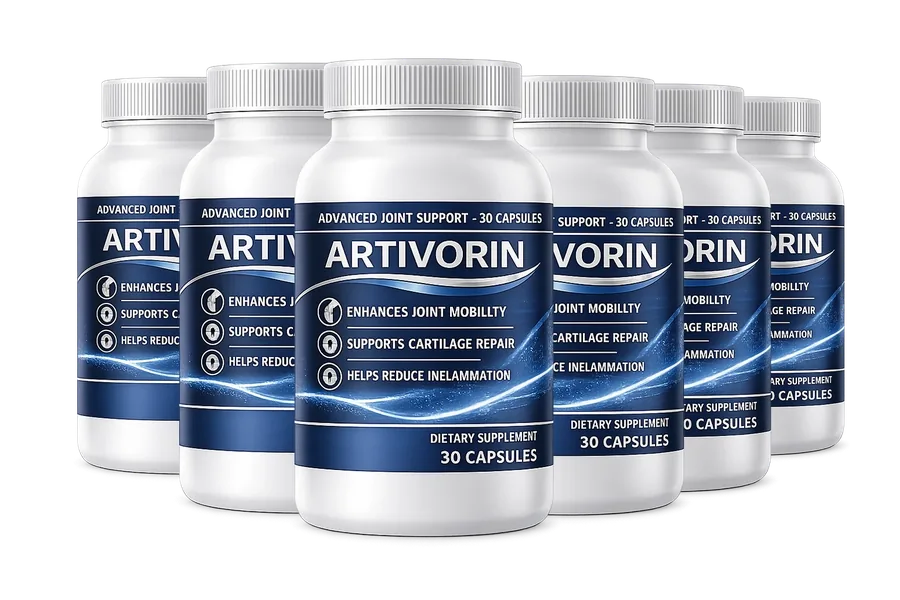
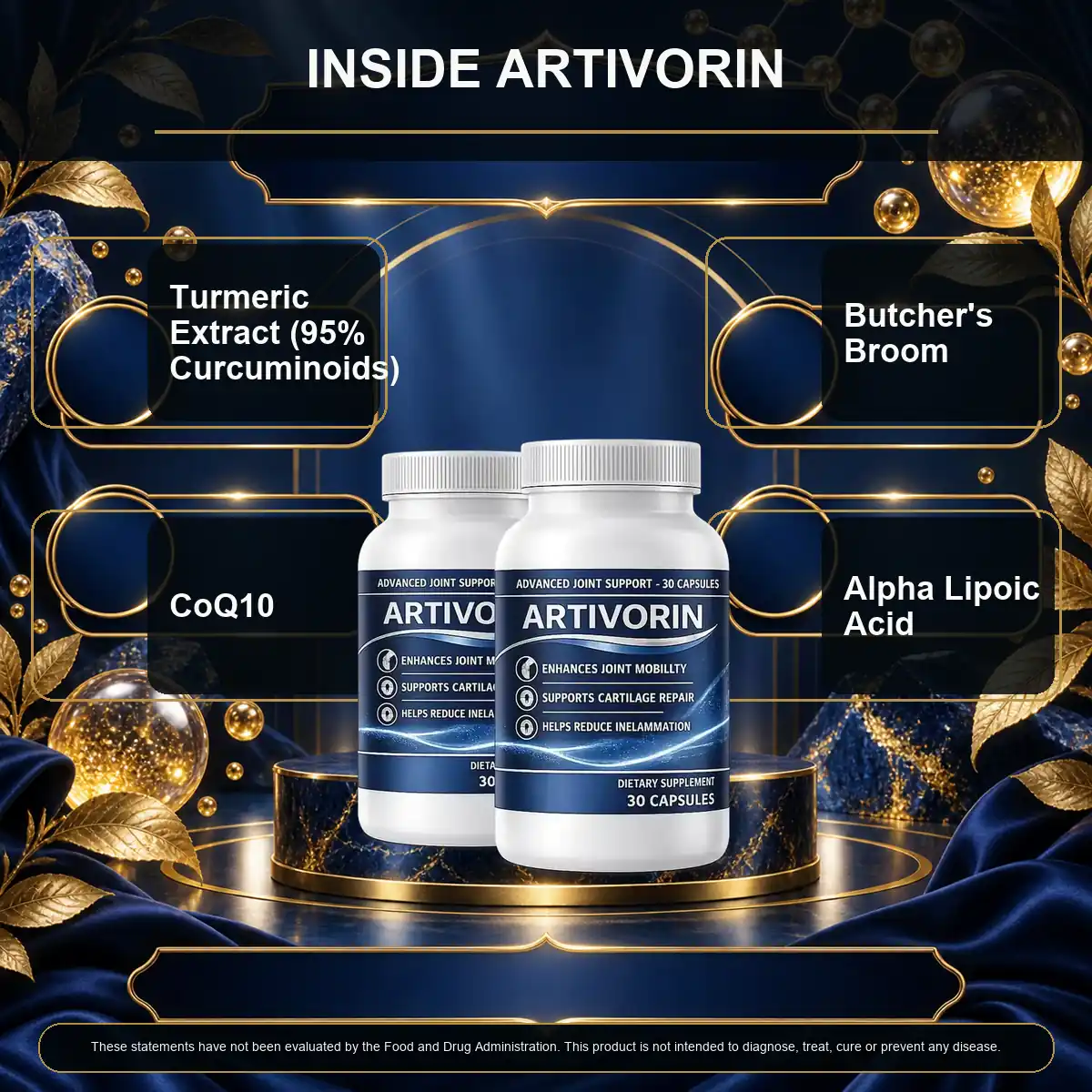
Artivorin lists four ingredients: turmeric extract, coenzyme Q10, butcher’s broom root and alpha-lipoic acid.
The turmeric is standardised to 95 per cent curcuminoids, the grade used in the knee trials. The label does not print an amount for each one.
For how the four are meant to work together, read how Artivorin works.
What the four substances are, how they reach a capsule, and exactly how much the label tells you about each one.
What is actually in Artivorin?
What each of the four is as a substance, where it is grown or grown in, and how it reaches a capsule.
Four substances, and they have almost nothing in common except that all four are sold as supplements. One is a spice pigment, one is a compound your mitochondria make, one is a shrub root from the Mediterranean and one is a fatty acid that behaves like a vitamin. Here is each of them as a material, before any question of what it does.
Turmeric Extract
Curcuma longa, rhizome95% curcuminoidsTurmeric is a rhizome, a thick underground stem in the ginger family, dug and dried across South Asia. The yellow in it comes from three closely related pigments — curcumin, demethoxycurcumin and bisdemethoxycurcumin — collectively the curcuminoids, and they make up perhaps three per cent of the dried root by weight.
An extract concentrates them. The phrase on this label, 95 per cent curcuminoids, describes a powder that has been solvent-washed until pigment is almost all that is left, which is the material the randomised knee trials were run on. It is the industry-standard grade and naming it is a point in this label's favour: a bottle that says only “turmeric” could be holding kitchen spice.
Coenzyme Q10
ubiquinone, CoQ10Made in the body tooNot a plant extract at all. Coenzyme Q10 is a fat-soluble quinone your own cells manufacture, sitting in the inner membrane of the mitochondria where it ferries electrons along the chain that ends in usable energy. Organ meats and oily fish supply small amounts; production falls with age and with statin therapy.
Supplement-grade CoQ10 is grown by yeast fermentation, then either left as ubiquinone, the oxidised form, or reduced to ubiquinol. The two absorb differently and cost differently. This label prints neither the form nor the amount, and the dose-response work on inflammatory markers settled on 300 to 400 mg a day, so the distinction is not academic.
Butcher’s Broom
Ruscus aculeatus, rhizome and rootA Mediterranean evergreenA spiny evergreen shrub of southern Europe and North Africa, stiff enough that bundles of it really were once sold to sweep butchers' blocks. The medicinal part is the underground rhizome, and the compounds of interest are steroidal saponins, ruscogenin and neoruscogenin among them.
Those saponins act on the smooth muscle in vein walls, which is why the trials of this plant measure ankles and calves. A 2025 phytochemistry review catalogues what is in the plant in detail. Nothing in that catalogue has been tested against a joint, and this desk has found no explanation from the seller for its presence on a joint label.
Alpha Lipoic Acid
thioctic acid, ALAWorks in water and in fatA short sulphur-bearing fatty acid, made in small quantities by human cells and found in spinach, broccoli and offal at amounts far below any supplement. Its chemistry is genuinely unusual: the disulphide ring dissolves in both water and fat, so it reaches compartments most antioxidants cannot, and it regenerates vitamin C and vitamin E after they have been spent.
Commercial alpha-lipoic acid is a mixture of two mirror-image forms, of which only the R form occurs naturally. The trials that made its name used 600 mg a day of the racemic mixture, taken on an empty stomach because food cuts absorption by around a third.
What “95% curcuminoids” means on the Artivorin label
One phrase on the bottle carries real information. Here is exactly how much of it, and where it stops.
It is the one technical phrase on this bottle, and it is worth ten seconds because it is also the one that separates a serious turmeric ingredient from a decorative one.
Standardisation is a promise about concentration, not about quantity. A powder standardised to 95 per cent curcuminoids has been processed until 95 grams in every hundred are the active pigments. Ordinary dried turmeric runs at two to five per cent, so the extract is roughly twenty to thirty times stronger by weight. Buy turmeric powder in a shop and you would need most of a tablespoon to match a gram of this material.
What the phrase cannot tell you is how much of the powder went into the capsule. Concentration multiplied by weight gives the dose, and this label prints the first number without the second. The trials that reported results in knees used 1,500 mg a day of curcuminoids, which would be roughly 1,580 mg of a 95 per cent extract — more than a size-0 capsule holds on its own, before three other ingredients are added.
So the standardisation figure should be read as evidence about the grade of material the manufacturer buys, and as nothing at all about how much of it is in front of you.
| The phrase on a label | What it fixes | What it leaves open |
|---|---|---|
| Turmeric (root) | The plant and the part, and nothing else. | Whether the material is spice-grade or an extract, and at what strength. |
| Turmeric extract | That the material has been concentrated somehow. | By how much, and against which marker compounds. |
| Turmeric extract, 95% curcuminoids | Grade and marker: 95 grams of pigment in every 100 of powder. | The weight of powder in the capsule, which is the number that decides the dose. |
| Turmeric extract, 95% curcuminoids, 500 mg | Grade, marker and weight together. This is the complete form. | Nothing material. The arithmetic is now possible and the figure would be 475 mg of curcuminoids. |
The Artivorin label reaches the third row and stops. Reading the fourth row is what lets a buyer of any turmeric product check the bottle against a trial.
Curcuminoids are poorly absorbed on their own, which is why most research-grade formulations pair them with something. The 1998 study everyone cites found that 20 mg of piperine, the pungent compound in black pepper, raised human serum curcumin sharply after a 2 g dose that on its own produced almost nothing measurable. Phospholipid and nanoparticle systems do the same job by other routes. No enhancer is named among these four ingredients.
What the Artivorin label leaves open
The questions the artwork does not answer, gathered here rather than repeated in every section above.
Every other section on this page describes what is in the capsule. This one gathers what the artwork does not settle, in one place, so it does not have to be mentioned in every paragraph above.
There is no Supplement Facts panel. Both of the seller's ingredient graphics — this domain's and the sister domain's differently illustrated one — set four names in four frames with no figure beside any of them, and every product photograph in both asset folders is a front three-quarter view, so no back-of-bottle shot exists to check against. A buyer holding the bottle may find more printing on it than the artwork shows; a buyer deciding online cannot.
Four things follow from that, and all four are practical rather than rhetorical.
| The open question | Why it matters | What a buyer can do about it |
|---|---|---|
| How many milligrams of turmeric extract | It decides whether the curcumin evidence applies to this capsule at all. The trials ran at 1,500 mg a day of curcuminoids. | Ring +1 (323) 347-4522 before ordering, and read the printing on the bottle when it arrives. |
| Which form of CoQ10 | Ubiquinone and ubiquinol absorb differently and are priced differently, and the inflammation work used 300 to 400 mg a day. | Same call. The answer is a single word and the desk either has it or does not. |
| What the capsule shell is made of | Gelatin and vegetable cellulose are both ordinary. Anyone avoiding one of them needs to know which is in the box. | Ask before buying rather than after, because an opened bottle is harder to return. |
| What else is in the capsule besides the four | Flow agents, fillers and anti-caking compounds are normal and are usually listed under an other-ingredients line. | The same call answers it. Allergen questions are the ones worth insisting on. |
Four questions, one telephone number, and about three minutes. This desk asks them of every product it sells and prints the answers when it has them.
None of this makes the product unusual in its category. Blends sold on long single pages frequently ship without a panel online, and the artwork is made for a sales page rather than for a regulator. It does mean that anyone who chooses supplements by reading panels will find nothing here to read, and that is a fair reason to buy something else.
What this desk will not do is fill the gap with an estimate. A plausible-looking milligram figure invented for the sake of a tidy table would be repeated by every site that copies this one, and within a month it would be treated as a fact about the bottle.
What a joint formula usually carries that Artivorin does not
Six names that turn up on most joint labels, and where this one stands against them.
Four named ingredients is a short list for this category. A survey of any shelf turns up the same handful of names again and again, and their absence here is a design choice with consequences in both directions.
| Usual in a joint formula | What it is there for | On the Artivorin list |
|---|---|---|
| Glucosamine sulphate | An amino sugar sold at 1,500 mg a day, the most-studied joint supplement there is and the one with the most contested result. | Absent. So is the debate that comes with it. |
| Chondroitin sulphate | A cartilage matrix component, usually paired with glucosamine at 800 to 1,200 mg. | Absent. |
| Methylsulfonylmethane (MSM) | An organic sulphur compound, commonly 1,000 to 3,000 mg a day. | Absent. |
| Boswellia serrata | A tree resin that ranked first for pain and stiffness in the 2025 network meta-analysis of seven supplements. | Absent, and it is the one this desk would most like to see here. |
| Type II collagen | Undenatured collagen at 40 mg, a newer entrant with a small trial record. | Absent. |
| A bioavailability enhancer | Piperine, a phospholipid complex or a nanoparticle system, used in most research-grade curcumin products. | Not named. Something may still be present and simply unprinted. |
Six names, none of which appears on either of the seller's ingredient graphics. A short list is not automatically a weak one, but it does narrow what the formula can be argued to do.
Read charitably, a four-ingredient capsule is a focused one. It avoids the kitchen-sink blend that puts fourteen names on a panel at amounts too small to do anything, and it leads with the ingredient that has the best joint evidence in the whole category.
Read sceptically, three of the four have their trial records elsewhere, and the cheapest way to buy the fourth is on its own, standardised, at a printed weight. Both readings are available from the same label, which is why the benefits page sets the claim lines out one by one and how it works takes the mechanisms apart.
Artivorin ingredient questions
How many ingredients does Artivorin name?
Four: turmeric extract standardised to 95 per cent curcuminoids, CoQ10, butcher’s broom and alpha-lipoic acid. The same four, in the same order, appear on the seller’s pack sheet and on both of its ingredient graphics.
Is there a proprietary blend?
No blend total appears anywhere, because no amounts appear anywhere. A proprietary blend at least gives one figure covering several ingredients; this artwork gives names only.
How much turmeric is in one capsule?
The seller has not printed a figure and this desk will not estimate one. For scale, the randomised knee trials used 1,500 mg a day of curcuminoids, which is about 1,580 mg of a 95 per cent extract.
Is the turmeric standardised?
Yes, to 95 per cent curcuminoids, which is the research grade. That is a statement about the strength of the powder rather than about how much of it went into the capsule.
Is butcher’s broom the same thing as broom or Scotch broom?
No. Butcher’s broom is Ruscus aculeatus, a spiny evergreen in the asparagus family. Scotch broom is Cytisus scoparius, an unrelated legume, and it is not interchangeable.
Does the capsule contain black pepper or piperine?
Neither is named among the four ingredients. If an enhancer is present it has not been printed, so a buyer should assume the curcuminoids are unaccompanied and read the absorption note above.
Is Artivorin vegetarian?
The label does not name the shell material, so this desk cannot say. Call +1 (323) 347-4522 and ask before ordering if it matters to you.
Sources behind the Artivorin ingredient list
Every study linked above, in the order the label names the ingredient it belongs to.
- Panahi Y, Rahimnia AR, Sharafi M, et al. Curcuminoid treatment for knee osteoarthritis: a randomized double-blind placebo-controlled trial. Phytother Res. 2014;28(11):1625-31. PMID 24853120. Dose: 1,500 mg/day of curcuminoids in three divided doses for 6 weeks. https://pubmed.ncbi.nlm.nih.gov/24853120/
- Shoba G, Joy D, Joseph T, et al. Influence of piperine on the pharmacokinetics of curcumin in animals and human volunteers. Planta Med. 1998;64(4):353-6. PMID 9619120. After 2 g of curcumin alone, human serum levels were undetectable or very low; 20 mg of piperine alongside it raised them sharply. https://pubmed.ncbi.nlm.nih.gov/9619120/
- Zhang Y, Gui Y, Adams R, et al. Comparative effectiveness of nutritional supplements in the treatment of knee osteoarthritis: a network meta-analysis. Nutrients. 2025;17(15):2547. PMID 40806131. Thirty-nine randomised trials, 4,599 patients; Boswellia ranked first for pain and stiffness, curcumin among those showing benefit on some outcomes. https://pubmed.ncbi.nlm.nih.gov/40806131/
- Hou S, Tian Z, Zhao D, et al. Efficacy and optimal dose of coenzyme Q10 supplementation on inflammation-related biomarkers: a GRADE-assessed systematic review and updated meta-analysis of randomized controlled trials. Mol Nutr Food Res. 2023;67(13):e2200800. PMID 37118903. Dose: 300-400 mg/day showed the strongest effect on inflammatory mediators. https://pubmed.ncbi.nlm.nih.gov/37118903/
- Boyle P, Diehm C, Robertson C. Meta-analysis of clinical trials of Cyclo 3 Fort in the treatment of chronic venous insufficiency. Int Angiol. 2003;22(3):250-62. PMID 14612852. Dose: capsules of 150 mg Ruscus aculeatus root extract with 150 mg hesperidin methyl chalcone and 100 mg ascorbic acid. https://pubmed.ncbi.nlm.nih.gov/14612852/
- Pacula W, Sowa I, Feldo M, et al. Current insights into the phytochemistry and pharmacological properties of Ruscus aculeatus. Molecules. 2025;30(22):4417. PMID 41302473. https://pubmed.ncbi.nlm.nih.gov/41302473/
- Ziegler D, Ametov A, Barinov A, et al. Oral treatment with alpha-lipoic acid improves symptomatic diabetic polyneuropathy: the SYDNEY 2 trial. Diabetes Care. 2006;29(11):2365-70. PMID 17065669. Doses: 600, 1,200 and 1,800 mg once daily for 5 weeks; the authors concluded 600 mg gave the best risk-to-benefit ratio. https://pubmed.ncbi.nlm.nih.gov/17065669/
Order Artivorin with the ingredient list in front of you
Four named actives led by turmeric extract at 95 per cent curcuminoids, one capsule a day, 30 to a bottle, and 60 days from purchase to change your mind.
Two bottles $178 · six bottles $294 · 60-day money-back guarantee
Order Artivorin On The Official WebsiteLot ART-26/MY-2615 · one a day · 30 in every bottle