Artivorin Official Website › How it works
How it worksHow Does Artivorin Work? The Four Pathways Explained
Artivorin works through four ingredients that each act in a different way.
Curcuminoids act on inflammatory signalling and have knee trials behind them. CoQ10 works in the mitochondria, butcher’s broom supports vein wall tone, and alpha-lipoic acid recycles used antioxidants.
For the daily routine, see how to take Artivorin.
Four mechanisms, taken one at a time, with the point at which each one runs out of evidence marked.
The four mechanisms Artivorin is built on
Four stories about how a capsule could act, told separately because they have almost nothing to do with each other.
A mechanism is a story about how a substance could produce an effect. It is useful, it is checkable in a laboratory, and it is not the same thing as a result in a person. Each of these four has one, and they are four different stories.
Curcuminoids and inflammatory signalling
An arthritic joint is not simply worn. The tissue around it produces signalling molecules — interleukins, tumour necrosis factor, C-reactive protein further downstream — and those signals drive both the discomfort and part of the ongoing damage. Curcuminoids interfere with several of the transcription steps that switch those signals on, which is well established in cell work.
The question is whether that reaches a knee. A 2025 systematic review pooled the randomised trials that measured inflammatory markers in the blood of people with knee osteoarthritis and found changes in them. That is the closest thing to a mechanism confirmed in humans on this label, and it is still a blood measurement rather than a joint one.
CoQ10 and the mitochondria
Coenzyme Q10 carries electrons between complexes in the respiratory chain, the assembly line that turns food into adenosine triphosphate. Cells with high energy demand hold the most of it. The supplement argument runs that ageing tissue, including the tissue around a joint, produces energy less efficiently and generates more oxidative by-product as it does so.
Tested in people, that argument has been taken furthest in muscle rather than in cartilage: a 2018 meta-analysis found a reduction in statin-associated muscle symptoms, while a 2020 analysis of the same question found none. Two competent reviews disagreeing is what an honest evidence base looks like part way through.
Ruscogenins and venous tone
Butcher’s broom saponins act on the adrenergic receptors in the smooth muscle of vein walls, tightening them so that blood is returned upward more efficiently and less fluid leaks into the surrounding tissue. It is a circulation mechanism and it is a real one: a 166-patient placebo-controlled trial measured leg volume over twelve weeks and a 2025 review of venoactive compounds still lists it among the working agents.
Applied to a joint, the argument would have to be that better local circulation helps a stiff knee. It is not an absurd idea. It is also an idea with no trial behind it, and this desk has not found one.
Alpha-lipoic acid and the antioxidant network
Antioxidants are spent when they work. Alpha-lipoic acid is one of the few that recycles the others, restoring oxidised vitamin C and vitamin E to their active forms, and its dual solubility lets it do so on both sides of a cell membrane. It also chelates certain metal ions that catalyse oxidative reactions.
A dose-response meta-analysis of the randomised trials found measurable movement in inflammatory markers, which is the same indirect argument CoQ10 makes and rests on the same assumption: that a marker in the blood tracks something happening in the joint. That assumption is reasonable and it is not proven.
Where the Artivorin evidence actually stops
Three questions in increasing order of difficulty, and where each ingredient gets to.
Three questions separate a mechanism from a claim, and they get harder in order. Does the substance do something in a dish? Does it move a marker in a person? Does the person feel or function differently? Here is where each of the four stands.
| Ingredient | Acts in laboratory work | Moves a marker in people | Changes symptoms in a joint |
|---|---|---|---|
| Turmeric extract | Yes, extensively | Yes, in knee osteoarthritis trials | Yes. A 2024 review of eleven meta-analyses found reported improvements in pain and function. |
| Coenzyme Q10 | Yes | Yes, in inflammation and in muscle | No trial in joints has been run. |
| Butcher’s broom | Yes, on venous smooth muscle | Yes, on leg volume and venous symptoms | No trial in joints has been run. |
| Alpha-lipoic acid | Yes | Yes, in inflammatory markers and in nerve function | No trial in joints has been run. |
The last column is the one a buyer is paying for. One of four fills it, and that one is the ingredient the label leads with.
The row that does fill it is worth reading carefully rather than triumphantly. The curcumin trials are mostly small, mostly short, and mostly run in knees rather than hands or hips. Their consistency is what makes them persuasive, not the size of any one of them.
The three empty rows are not evidence of failure either. Nobody has run the trial, which is different from somebody running it and finding nothing. What it means practically is that three quarters of this formula is being asked to work on an argument rather than on a result.
How much you need. Every mechanism above is described without a quantity, because mechanisms do not have quantities — trials do. The curcuminoid work ran at 1,500 mg a day, the CoQ10 inflammation work at 300 to 400 mg, the ruscus trials at 150 mg of root extract per capsule and the alpha-lipoic acid trials at 600 mg. Those four figures and the Artivorin label cannot be compared, because the label carries no figures. That is set out in full on the ingredients page.
What Artivorin does in a day, practically speaking
What the pharmacology suggests and what a once-daily capsule can realistically deliver.
One capsule, swallowed. Nothing in this formula is fast, and nothing in it is meant to be felt within an hour the way caffeine or an anti-inflammatory tablet is. That is worth saying plainly because the commonest disappointment in this category comes from expecting the wrong kind of effect.
Curcuminoids reach peak blood levels within a few hours and clear quickly, which is why the trials dosed three times daily rather than once. Alpha-lipoic acid has a half-life measured in tens of minutes. CoQ10 accumulates slowly over weeks in tissue. A once-daily capsule is a compromise between what the pharmacology wants and what a person will actually keep doing.
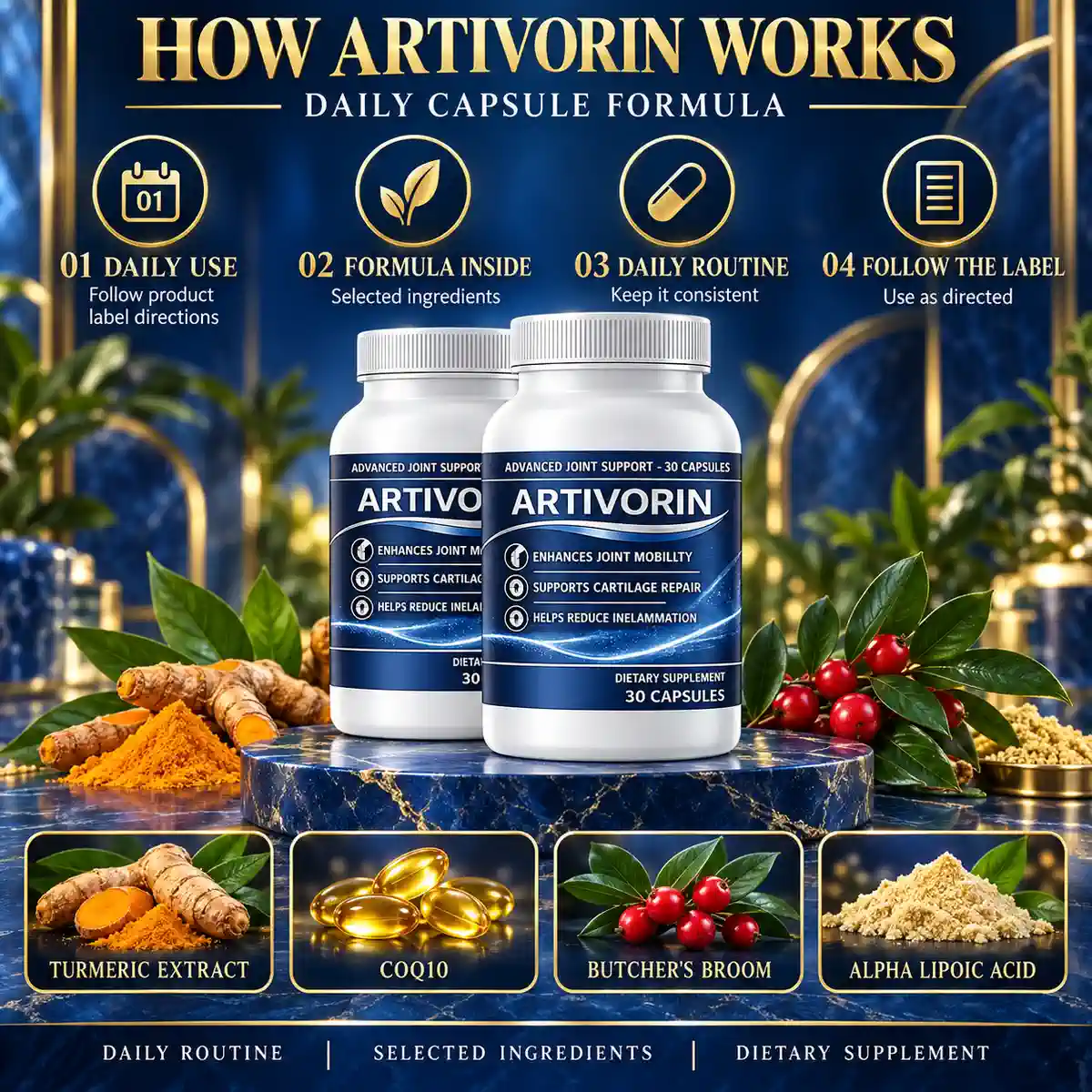
The seller’s own artwork sets out four numbered steps, three of which amount to taking it consistently and reading the label. As a mechanism diagram it explains nothing; as a statement about what the seller expects of a buyer it is accurate enough.
Why Artivorin combines these four and not others
Three reasons a formula gathers ingredients, and which of them applies here.
Formulators combine ingredients for three reasons: because they act on the same target from different angles, because one helps another get absorbed, or because each has its own following and a longer list sells better. The first two are scientific; the third is commercial, and it is not dishonest as long as nothing is claimed for it.
On this label, only the first argument is available. There is no absorption pairing — none of the other three is an established enhancer of curcuminoids — so the case has to be that four antioxidant and circulatory mechanisms converge on a stiff joint from four directions.
That case is coherent and it is untested as a combination. No trial has given these four together to anybody. A formula is not the sum of its citations, and a reader who adds up thirty curcumin trials, six ruscus trials and two four-year alpha-lipoic acid trials has counted evidence for three separate products.
What the four-ingredient argument has going for it
- The lead ingredient is the one with the strongest joint evidence in the whole supplement category, at research grade.
- Four ingredients rather than fourteen, which at least means nothing is present purely to lengthen a list.
- Three of the four have long safety records in ordinary supplement use.
- The mechanisms proposed are antioxidant and circulatory rather than anything hormonal or stimulant, which is the low-risk end of this category.
What it cannot answer
- No trial has tested this combination, so its benefit is argued rather than measured.
- Three of the four have no randomised trial in joints of any kind.
- No bioavailability enhancer is named alongside the curcuminoids.
- Without printed amounts, no reader can tell whether any mechanism above is operating at a meaningful scale.
Questions about how Artivorin works
How does Artivorin work?
Through four separate proposed mechanisms: curcuminoids interfering with inflammatory signalling, CoQ10 supporting mitochondrial energy production, butcher’s broom saponins tightening vein walls, and alpha-lipoic acid recycling spent antioxidants. Only the first has been tested in joints.
Does it work on the cause or the symptom?
Neither has been demonstrated for this capsule. The curcumin trials measured symptoms — pain scores and function scores — and did not image cartilage, so a structural claim has nothing behind it.
How fast does it act in the body?
Curcuminoids peak in the blood within hours and clear quickly. CoQ10 accumulates over weeks. Alpha-lipoic acid clears within an hour. None of that is felt, which is why the timeline is measured in weeks rather than doses.
Is there a trial of the finished capsule?
No. Every study cited on this website tested a single ingredient, usually at a dose this label does not print. A citation for an ingredient is not a citation for a product.
Why would a vein herb be in a joint formula?
The charitable reading is local circulation around the joint. No trial has tested that idea, and the seller has offered no explanation, so this site reports the ingredient rather than the rationale.
Does it need to be taken forever to keep working?
The trials ran six weeks to four years and none followed people after stopping. Nothing in the pharmacology suggests a lasting change once the capsules stop, which is true of most supplements in this category.
Sources for how Artivorin is said to work
The trials and reviews linked in the sections above, grouped by the ingredient whose mechanism they belong to.
- Hsueh HC, Ho GR, Tzeng SI, et al. Effects of curcumin on serum inflammatory biomarkers in patients with knee osteoarthritis: a systematic review and meta-analysis of randomized controlled trials. BMC Complement Med Ther. 2025;25(1):237. PMID 40615851. https://pubmed.ncbi.nlm.nih.gov/40615851/
- Bideshki MV, Jourabchi-Ghadim N, Radkhah N, et al. The efficacy of curcumin in relieving osteoarthritis: a meta-analysis of meta-analyses. Phytother Res. 2024;38(6):2875-2891. PMID 38576215. https://pubmed.ncbi.nlm.nih.gov/38576215/
- Qu H, Guo M, Chai H, et al. Effects of coenzyme Q10 on statin-induced myopathy: an updated meta-analysis of randomized controlled trials. J Am Heart Assoc. 2018;7(19):e009835. PMID 30371340. https://pubmed.ncbi.nlm.nih.gov/30371340/
- Kennedy C, Koller Y, Surkova E. Effect of coenzyme Q10 on statin-associated myalgia and adherence to statin therapy: a systematic review and meta-analysis. Atherosclerosis. 2020;299:1-8. PMID 32179207. https://pubmed.ncbi.nlm.nih.gov/32179207/
- Vanscheidt W, Jost V, Wolna P, et al. Efficacy and safety of a Butcher's broom preparation (Ruscus aculeatus L. extract) compared to placebo in patients suffering from chronic venous insufficiency. Arzneimittelforschung. 2002;52(4):243-50. PMID 12040966. Twelve weeks; the endpoint was leg volume, not joint pain. https://pubmed.ncbi.nlm.nih.gov/12040966/
- Gloviczki ML, Kakkos SK, Urbanek T, et al. The role of venoactive compounds in the treatment of chronic venous disease. J Vasc Surg Venous Lymphat Disord. 2025;13(5):102258. PMID 40348378. https://pubmed.ncbi.nlm.nih.gov/40348378/
- Vajdi M, Mahmoudi-Nezhad M, Farhangi MA. An updated systematic review and dose-response meta-analysis of the randomized controlled trials on the effects of alpha-lipoic acid supplementation on inflammatory biomarkers. Int J Vitam Nutr Res. 2023;93(2):164-177. PMID 33827267. https://pubmed.ncbi.nlm.nih.gov/33827267/
Order Artivorin knowing which mechanism has trials behind it
Turmeric extract leads the label and carries the joint evidence. One capsule a day, 30 to a bottle, 60 days from the transaction in which to send it back.
Two bottles $178 · six bottles $294 · 60-day money-back guarantee
Order Artivorin On The Official WebsiteLot ART-26/MY-2615 · one a day · 30 in every bottle