Artivorin Official Website › Blog › Butcher’s Broom Is A Vein Herb
Butcher’s Broom Is A Vein Herb, Not A Joint One
Ruscus aculeatus has a respectable clinical file and every page of it is about legs. Paired with osteoarthritis, arthritis or joint pain, PubMed returns nothing at all. Here is what the plant actually does, and why it keeps appearing on joint labels.
- Butcher’s broom is Ruscus aculeatus, a spiny Mediterranean evergreen in the asparagus family.
- Its medicinal part is the underground rhizome and root, and its active compounds are steroidal saponins including ruscogenin.
- Every randomised trial of it is in chronic venous insufficiency, and the endpoint is leg volume.
- The pooled trials used capsules of 150 mg of root extract alongside hesperidin methyl chalcone and vitamin C.
- Searched against osteoarthritis, arthritis or joint pain, it returns no records. That is zero, not a small number.
What the plant is
Ruscus aculeatus is a low evergreen shrub of southern Europe and North Africa with flattened stems that look like leaves and end in sharp points. It is stiff enough that bundles of it really were once used to scour butchers’ blocks, which is where the common name comes from and is the only genuinely charming fact in this article.
It is in the asparagus family, and it is not related to Scotch broom, Cytisus scoparius, which is a legume with a different chemistry and a different set of cautions. A label printing only the word broom has left that ambiguity open.
The part used medicinally is the underground rhizome and root. A 2025 phytochemistry review catalogues what is in it: steroidal saponins, principally ruscogenin and neoruscogenin, alongside flavonoids and sterols. Those saponins are the reason the plant has a clinical file at all.
The clinical record, which is entirely venous
| The study | Condition studied | What it measured |
|---|---|---|
| Vanscheidt 2002, 166 patients, placebo-controlled | Chronic venous insufficiency | Leg volume over twelve weeks |
| Boyle 2003, meta-analysis of the standard combination | Chronic venous insufficiency | Pooled trials of capsules containing 150 mg of ruscus root extract with hesperidin methyl chalcone and ascorbic acid |
| Kakkos 2018, review | Chronic venous disease | A review of the accumulated evidence for the same preparation |
| Gloviczki 2025, review of venoactive compounds | Chronic venous disease | Where the ingredient sits in current practice |
| Pacula 2025, phytochemistry review | The plant itself | What compounds Ruscus aculeatus actually contains |
Five records, one condition. Searched against osteoarthritis, arthritis or joint pain, PubMed returns no records for this plant at all.
Five records, and they are not a thin file. The 2002 trial randomised 166 patients against placebo over twelve weeks and measured leg volume, which is the standard endpoint in chronic venous insufficiency. A meta-analysis of the standard three-part combination pooled the clinical trials of capsules containing 150 mg of ruscus root extract with hesperidin methyl chalcone and ascorbic acid.
A 2018 review revisited that evidence, and a 2025 review of venoactive compounds places it among the agents still in use for chronic venous disease today. This is an ingredient with two decades of continuous clinical attention behind it.
All of it in the veins. Not one paper in that file measures a joint, and the search that would find one returns nothing.
Paired with osteoarthritis, and separately with arthritis or joint pain, a PubMed search for this plant returns no records. That is different from a small number of negative trials, and it is different again from an ingredient nobody has studied. Ruscus has been studied thoroughly, somewhere else.
How it works, and why the mechanism is not a joint mechanism
The saponins in ruscus act on adrenergic receptors in the smooth muscle of vein walls, increasing venous tone. A vein with more tone returns blood upward more efficiently and leaks less fluid into the surrounding tissue, which is why the trials measure ankle circumference and calf volume rather than pain scores.
That is a coherent, specific, well-described mechanism, and it is a mechanism about vessels. Applied to a joint, the argument would have to run that better local circulation around a knee improves how the knee feels or functions.
It is not an absurd argument. Tissue around an arthritic joint is real tissue with a real blood supply. What it is not is a tested argument: nobody has run the trial, and until somebody does, an ingredient chosen on that basis is a hypothesis in a capsule.
What would settle it
- A randomised trial of ruscus extract in osteoarthritis, at a stated dose, against placebo, measured on a standard joint index.
- Or, less ambitiously, a trial measuring joint swelling rather than leg volume, since swelling is where the venous mechanism would most plausibly show.
- Or a trial of a blend containing it, which at least would tell you whether the combination does something even if it could not say which part.
- None of those exists. That is the honest position and it will stay the honest position until somebody funds one.
Four ingredients, and one of them has joint trials
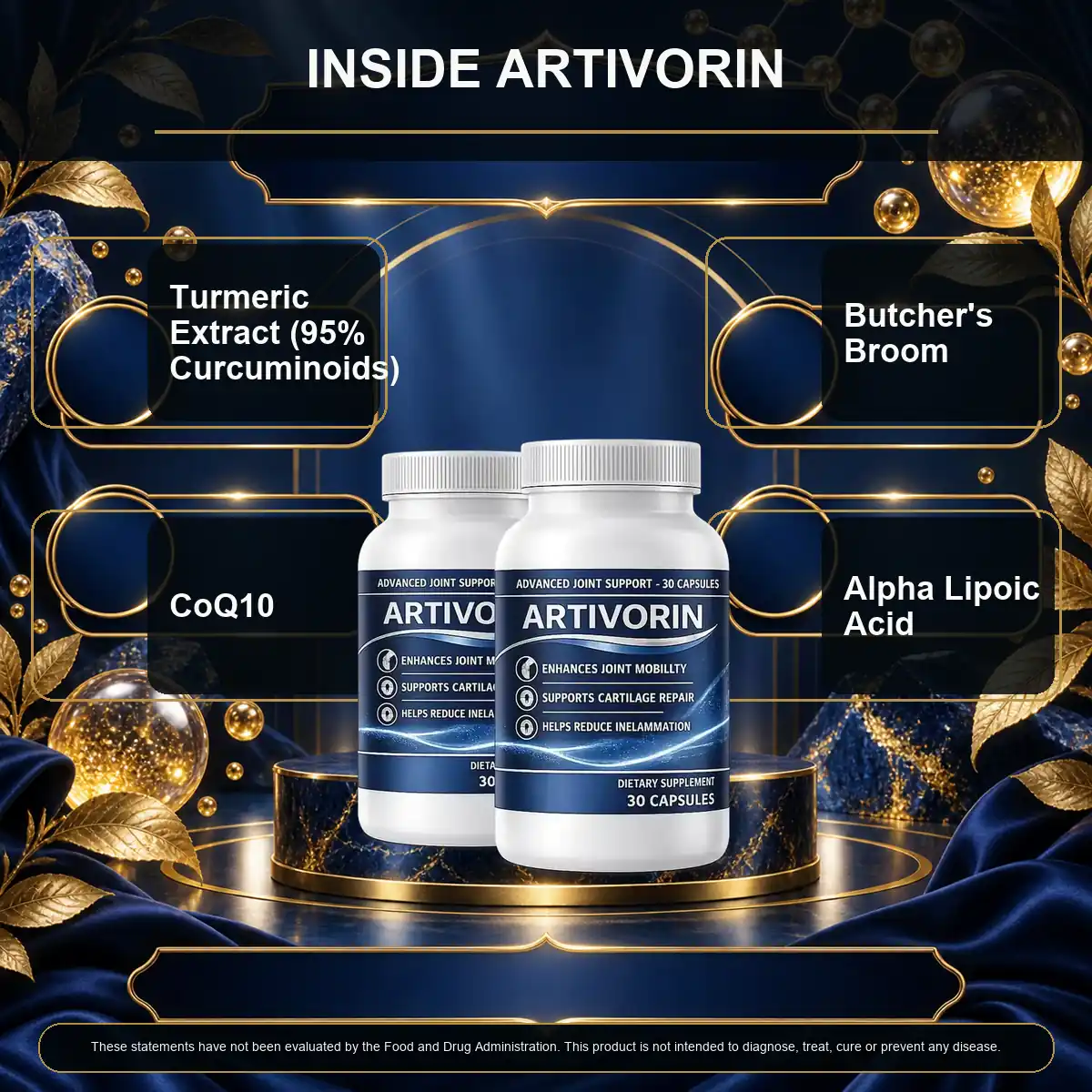
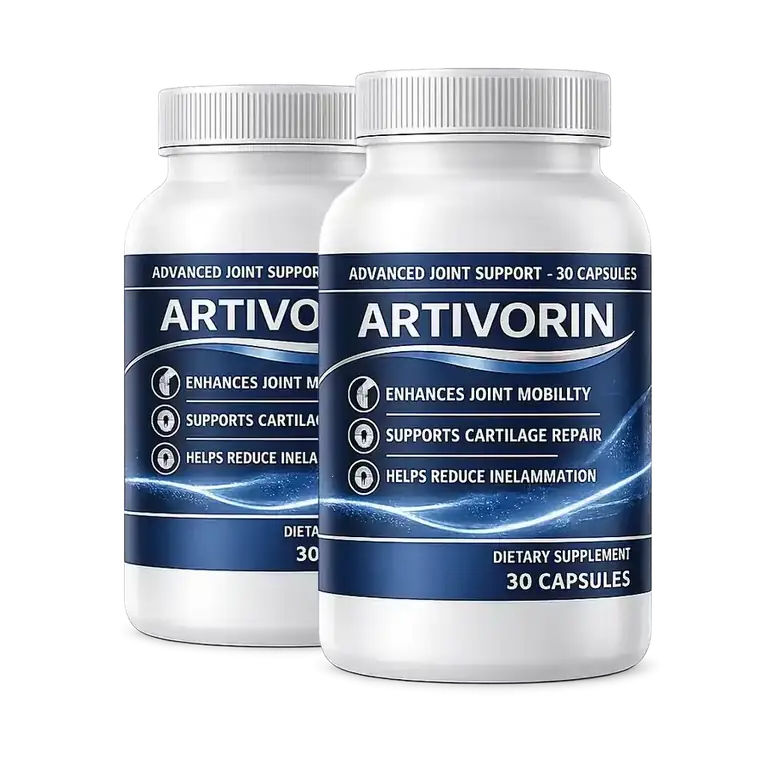
Artivorin names turmeric extract at 95 per cent curcuminoids, CoQ10, butcher’s broom and alpha-lipoic acid. The first has thirty randomised trials in osteoarthritis. The other three have none, and this desk says so on every page where they appear.
Two bottles $178 · six bottles $294 · 60-day money-back guarantee
Order Artivorin On The Official WebsiteLot ART-26/MY-2615 · one a day · 30 in every bottle
Why it reaches joint labels at all
Three explanations are available and they are not mutually exclusive.
The generous one is the circulation argument above, taken seriously by a formulator who thought vascular support around a joint was worth including. The neutral one is that an ingredient with a real clinical file and a memorable name adds credibility to a list. The uncharitable one is that it is cheap, available, and looks like a botanical.
Nothing on the labels this desk has read distinguishes between the three, because none of them explains the choice at all. A seller who included it for the first reason would probably say so, and it is worth noticing when nobody does.
| Ingredient | Where its trials are | How it reaches a joint label |
|---|---|---|
| Butcher’s broom | Chronic venous insufficiency, measured as leg volume | Circulation, argued generally rather than demonstrated in a joint |
| Coenzyme Q10 | Statin-associated muscle symptoms, inflammatory markers | Mitochondrial energy, argued from tissue biology |
| Alpha-lipoic acid | Diabetic polyneuropathy, at 600 mg a day | Antioxidant recycling, argued from marker studies |
| Grape seed extract | Cardiovascular work | Antioxidant capacity, argued generally |
| Curcumin | Knee osteoarthritis, in 30 randomised trials | It does not need to be argued. It was tested in the condition on the bottle |
Four of these five reach joint labels by analogy. One reaches them by trial. The difference is the single most useful thing to notice about any ingredient list.
It is also worth being fair about what a formulator is working with. Ingredients arrive with a documented safety record, a supply chain and a price, and very few of them arrive with trials in the exact condition a finished product is sold for. Building a joint supplement entirely from ingredients tested in joints would leave a formulator with curcumin, Boswellia, collagen and not much else, at a considerably higher cost per capsule.
So borrowing is the norm rather than the exception, and a buyer who treated it as disqualifying would leave the shelf empty. What separates one label from another is whether the borrowing is acknowledged, whether the lead ingredient is one of the tested ones, and whether the amounts are printed so that the tested one can be checked.
That table is the general version of the problem and it is worth carrying beyond this one plant. Four of those five ingredients arrive on a joint label by analogy from another field of medicine. One arrives by trial in the condition printed on the front of the bottle.
A buyer counting names on a label is counting the wrong thing. What matters is how many of those names have been tested in the condition the label is sold for, and on most joint products in this category the answer is one or zero.
How to read a borrowed ingredient
- Look it up against the condition, not on its own. An ingredient with a thousand papers may have none in the condition you are buying for.
- Find the plant part. Root, rhizome, leaf, bark, seed and fruit are different ingredients with different chemistry, and the research almost always sits under one.
- Find the amount the trials used. For ruscus it is 150 mg of root extract per capsule, in combination. A product at a tenth of that is a name rather than a dose.
- Ask what the seller says the ingredient is for. Silence is an answer, and it is the answer most often given.
- Do not treat a borrowed ingredient as a fault by itself. Formulators combine things for reasons, and some of those reasons are good. Treat it as an unanswered question rather than as a scandal.
The reasonable conclusion about butcher’s broom is not that it does nothing. It demonstrably does something, in legs, at 150 mg of root extract in combination with two other compounds, over twelve weeks.
The reasonable conclusion is that its presence on a joint label is unexplained, that no trial supports it there, and that a buyer counting four ingredients on a joint bottle should probably be counting one. That is not a comfortable sentence for a retail site to publish and it is the accurate one.
References
- Vanscheidt W, Jost V, Wolna P, et al. Efficacy and safety of a Butcher's broom preparation (Ruscus aculeatus L. extract) compared to placebo in patients suffering from chronic venous insufficiency. Arzneimittelforschung. 2002;52(4):243-50. PMID 12040966. Twelve weeks; the endpoint was leg volume, not joint pain. https://pubmed.ncbi.nlm.nih.gov/12040966/
- Boyle P, Diehm C, Robertson C. Meta-analysis of clinical trials of Cyclo 3 Fort in the treatment of chronic venous insufficiency. Int Angiol. 2003;22(3):250-62. PMID 14612852. Dose: capsules of 150 mg Ruscus aculeatus root extract with 150 mg hesperidin methyl chalcone and 100 mg ascorbic acid. https://pubmed.ncbi.nlm.nih.gov/14612852/
- Kakkos SK, Bouskela E, Jawien A, et al. New data on chronic venous disease: a new place for Cyclo 3 Fort. Int Angiol. 2018;37(1):85-92. PMID 29063748. https://pubmed.ncbi.nlm.nih.gov/29063748/
- Gloviczki ML, Kakkos SK, Urbanek T, et al. The role of venoactive compounds in the treatment of chronic venous disease. J Vasc Surg Venous Lymphat Disord. 2025;13(5):102258. PMID 40348378. https://pubmed.ncbi.nlm.nih.gov/40348378/
- Pacula W, Sowa I, Feldo M, et al. Current insights into the phytochemistry and pharmacological properties of Ruscus aculeatus. Molecules. 2025;30(22):4417. PMID 41302473. https://pubmed.ncbi.nlm.nih.gov/41302473/