Artivorin Official Website › Blog › How Long A Joint Supplement Takes
How Long Does A Joint Supplement Take To Work?
Six weeks is the shortest honest answer anywhere in this category, and almost nobody waits that long. Here is what the trials actually measured, when they measured it, and how to run a test that produces an answer instead of an impression.
- No trial of any common joint supplement ingredient measured a change at seven days.
- Six weeks is the shortest period in which a positive result has been reported for curcumin in knee osteoarthritis, at 1,500 mg a day of curcuminoids.
- Several ingredients on joint labels have their evidence in other conditions entirely, and their timelines belong to those conditions.
- The commonest reason a supplement is judged to have failed is that it was judged in week two.
- A refund window shorter than eight weeks cannot cover a fair test, which is worth knowing before choosing where to buy.
Why this category is slow, and what that means
A painkiller works by occupying a receptor or blocking an enzyme, and the effect arrives and departs with the drug. Almost nothing sold for joints works that way. The proposed mechanisms are about signalling, oxidation and tissue over weeks, and the effects they produce are accrual effects rather than acute ones.
That distinction is not a technicality. It decides what a reasonable expectation looks like, and it explains almost every disappointed review in this category. Somebody who has taken an anti-inflammatory tablet knows what a joint responding to a drug feels like, and they go looking for that sensation on day three of a capsule that cannot produce it.
It also explains why the marketing so often implies otherwise. A seller who tells you the honest number loses the purchase to a seller who does not, which is a commercial reality rather than a conspiracy, and it is the reason the number is worth carrying with you.
Three different clocks in one bottle
A blend complicates the question further, because the ingredients in it frequently run on different timescales. A fat-soluble compound that accumulates in tissue over weeks behaves nothing like one that clears from the blood in under an hour, and a blend containing both has two clocks in it.
Where a product carries four or five ingredients, the honest timeline is set by the slowest one with any evidence behind it. In practice that usually means curcumin, and in practice that means six weeks.
What the trials actually measured, and when
The table below collects the durations from the studies most often cited on joint supplement labels. It is worth reading as a set rather than one row at a time, because the pattern is the point.
| The study | What it tested | How long before it measured anything |
|---|---|---|
| Panahi 2014, knee osteoarthritis | 1,500 mg a day of curcuminoids in three divided doses | Six weeks, and that is the shortest positive result in this ingredient |
| Kuptniratsaikul 2014, 367 patients | The same daily amount, against ibuprofen at 1,200 mg a day | Four weeks, with the comparator drug running the same course |
| The 2024 umbrella review | Eleven meta-analyses of curcumin in osteoarthritis | The pooled studies mostly ran six to sixteen weeks |
| Vanscheidt 2002, chronic venous insufficiency | A butcher’s broom preparation against placebo | Twelve weeks, measuring leg volume |
| NATHAN 1, diabetic polyneuropathy | 600 mg a day of alpha-lipoic acid in 460 patients | Four years |
Five studies from three different fields of medicine. Not one of them measured anything at seven days, and the shortest of them is six times longer than the period most buyers give a supplement before deciding.
Two of those five rows are not about joints at all, and that is not an error in the table. The butcher’s broom trial measured leg volume in chronic venous insufficiency, and NATHAN 1 followed nerve function in people with diabetes for four years. Both appear here because both ingredients turn up on joint labels, and a buyer comparing timelines needs to know which department each figure comes from.
The three rows that are about joints all belong to one ingredient. The 2014 randomised trial ran six weeks at 1,500 mg a day of curcuminoids in three divided doses. The 367-patient comparison with ibuprofen ran four weeks at the same daily amount, which is the shortest positive joint result in the modern literature and was measured against an actual drug. The 2024 umbrella review of eleven meta-analyses pools studies that mostly ran six to sixteen weeks.
Six weeks. If a product, a review or a friend tells you that a joint supplement works in days, the claim is outside everything that has been measured, whatever the ingredient and whatever the price.
Week by week, for any product in this category
| Point in the course | What is physiologically plausible | What usually happens |
|---|---|---|
| Days 1–7 | Nothing in the joint. Compounds at this scale do not produce an acute effect. | The stomach adjusts, or does not. This is where most people who abandon a supplement abandon it. |
| Weeks 2–4 | Tissue concentrations of the slower compounds build. Nothing measurable yet. | The habit either sticks or it does not, and the habit is the variable that decides everything afterwards. |
| Weeks 4–6 | The earliest window in which any trial of any ingredient on a joint label reported a change. | The first genuine signal, if there is going to be one. Modest and specific rather than dramatic. |
| Weeks 6–12 | Where most of the published effect sizes were measured. | The decision point. Also, on most products, the end of the refund window. |
| Past three months | Very little published evidence predicts further change. | A decision made on your own records, because nothing else can make it for you. |
The middle column describes what the research would predict for the ingredients in this category generally. It is not a prediction about any particular capsule.
The second column of that table is deliberately modest. Nothing in this category produces the kind of change that makes a good advertisement, and the trials that found an effect found a real, statistically detectable, clinically modest one.
Translated out of research language: stairs become less of a decision, mornings shorten, and the joint intrudes on fewer days. Not: the joint stops existing. A reader who expects the second will be disappointed by the first even when the first arrives.
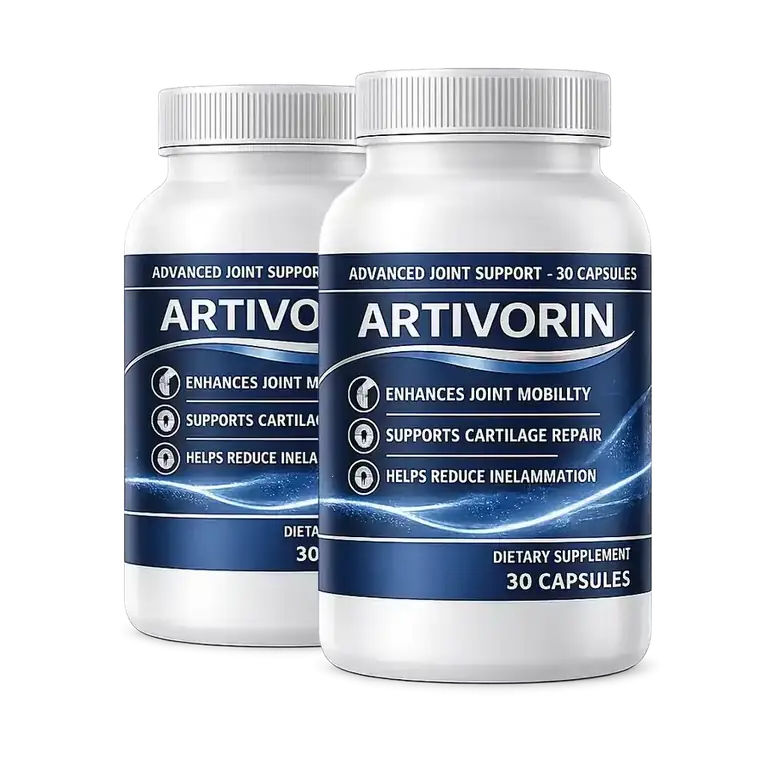
Artivorin is one capsule a day, and the wait is the same as the category’s
Four named ingredients led by turmeric extract at 95 per cent curcuminoids, 30 capsules to a bottle, and a 60-day window that covers a complete six-week test with a fortnight to spare.
Two bottles $178 · six bottles $294 · 60-day money-back guarantee
Order Artivorin On The Official WebsiteLot ART-26/MY-2615 · one a day · 30 in every bottle
What genuinely shortens the wait
Four things move the timeline and three popular ones do not. The distinction is worth knowing because the three that do not are the ones most often tried.
- Taking it with food that contains fat. Several of the ingredients in this category are fat-soluble, and absorption on an empty stomach is measurably worse. This is the single easiest change available.
- Taking it every day. An accrual effect needs accrual. A capsule taken five days in seven is a different product from one taken seven days in seven.
- Choosing an ingredient with an absorption partner where the ingredient needs one. Curcumin is the obvious case and it is covered in its own article.
- Adding the movement and the strength work at the same time. They outperform anything in a bottle and they change the same outcomes, so they shorten the time before something is noticeable.
- Doubling the dose does not work. These are not painkillers and they do not titrate. It is also the fastest way to turn a known amount into an unknown one.
- Stacking two products with the same ingredient does not work either. It makes the total incalculable and duplicates any interaction the ingredient carries.
- Switching product at week three does not work. It resets the clock and guarantees that neither product is ever given a fair run.
How to test it so the answer means something
Joint symptoms move with weather, sleep, activity and mood, which is why trials use instruments and why impressions are worthless. A domestic version takes about four minutes a week and it is the difference between knowing and guessing.
- Before the first capsule, write down three numbers. How many minutes the worst joint takes to loosen in the morning. How many flights of stairs you went down in a week without planning the descent. How many days in seven the joint decided something.
- Change nothing else for a fortnight. Starting a capsule, a walking routine and a new mattress in the same week makes whatever happens uninterpretable.
- Take the same three numbers at week four. Not a verdict, a mid-point, so that week eight lands on a line rather than against a memory.
- Take them again at week eight and compare. Against week zero, not against how you imagine week zero was.
- Write down the decision and why. One sentence. The next time a joint supplement is advertised to you, that sentence is worth more than the advertisement.
Morning stiffness clearing in noticeably fewer minutes, on most mornings rather than one good one. Stairs and slopes becoming unremarkable. Fewer days when the joint set the agenda. And nothing at all by week eight is also a result, which is precisely what the refund window exists for.
Why the refund window is part of the timeline
This is the practical consequence of everything above, and it is the reason a timeline article belongs on a retail site rather than in a journal.
A fair test of anything in this category needs eight weeks: six for the ingredient and two for the decision. A thirty-day return window cannot cover that, so a product sold with one is a product that has to be judged before the evidence would predict anything. A sixty-day window can, with a fortnight to spare.
Two practical rules follow. Start counting on the day the parcel arrives rather than the day you remember to, because most windows run from the date of purchase and the postage has already spent some of it. And make the decision five days before the window closes, not on the last day, because starting a claim means a telephone call during somebody else’s working hours.
The same logic decides how much to buy. A pack covering less than the trial period cannot produce an answer, and a pack covering six months cannot be returned if the answer turns out to be no. The rung that matches the window is almost always the right first purchase.
None of this is an argument against joint supplements. It is an argument against judging one in week two, which is what most people do and is why most people in this category finish with a cupboard of half-used bottles and no idea whether any of them worked.
The ingredient with the best evidence here needs six weeks. The rheumatology guideline recommends exercise and weight management first, and both of those need longer than that. Nothing about joints is fast, and a buyer who accepts that at the start is the buyer most likely to get something out of it.
References
- Panahi Y, Rahimnia AR, Sharafi M, et al. Curcuminoid treatment for knee osteoarthritis: a randomized double-blind placebo-controlled trial. Phytother Res. 2014;28(11):1625-31. PMID 24853120. Dose: 1,500 mg/day of curcuminoids in three divided doses for 6 weeks. https://pubmed.ncbi.nlm.nih.gov/24853120/
- Kuptniratsaikul V, Dajpratham P, Taechaarpornkul W, et al. Efficacy and safety of Curcuma domestica extracts compared with ibuprofen in patients with knee osteoarthritis: a multicenter study. Clin Interv Aging. 2014;9:451-8. PMID 24672232. Dose: 1,500 mg/day of Curcuma domestica extract against ibuprofen 1,200 mg/day for 4 weeks. https://pubmed.ncbi.nlm.nih.gov/24672232/
- Bideshki MV, Jourabchi-Ghadim N, Radkhah N, et al. The efficacy of curcumin in relieving osteoarthritis: a meta-analysis of meta-analyses. Phytother Res. 2024;38(6):2875-2891. PMID 38576215. https://pubmed.ncbi.nlm.nih.gov/38576215/
- Vanscheidt W, Jost V, Wolna P, et al. Efficacy and safety of a Butcher's broom preparation (Ruscus aculeatus L. extract) compared to placebo in patients suffering from chronic venous insufficiency. Arzneimittelforschung. 2002;52(4):243-50. PMID 12040966. Twelve weeks; the endpoint was leg volume, not joint pain. https://pubmed.ncbi.nlm.nih.gov/12040966/
- Ziegler D, Low PA, Litchy WJ, et al. Efficacy and safety of antioxidant treatment with alpha-lipoic acid over 4 years in diabetic polyneuropathy: the NATHAN 1 trial. Diabetes Care. 2011;34(9):2054-60. PMID 21775755. Dose: 600 mg once daily for four years in 460 patients. https://pubmed.ncbi.nlm.nih.gov/21775755/
- Kolasinski SL, Neogi T, Hochberg MC, et al. 2019 American College of Rheumatology/Arthritis Foundation guideline for the management of osteoarthritis of the hand, hip, and knee. Arthritis Rheumatol. 2020;72(2):220-233. PMID 31908163. https://pubmed.ncbi.nlm.nih.gov/31908163/