Artivorin Official Website › Blog › Turmeric For Knees
Turmeric For Knees: The Dose The Trials Actually Used
Curcumin has the best randomised record of anything sold for joints, and almost every product using that reputation carries a fraction of the amount the research ran on. One multiplication tells you which kind you are holding.
- The randomised knee trials used 1,500 mg a day of curcuminoids, in three divided doses.
- A 95 per cent curcuminoid extract is 95 per cent active by weight, so 1,500 mg of curcuminoids means roughly 1,580 mg of powder.
- That is more than a single size-0 capsule holds on its own, before any other ingredient is added.
- Curcumin was measured against ibuprofen in a 367-patient trial and held its own on the standard scales.
- A 2025 network meta-analysis of seven supplements put Boswellia first for pain and stiffness, with curcumin among those showing benefit on some outcomes.
What the evidence actually is
Curcumin is unusual in this category in having a modern, consistent, randomised record rather than a reputation. A 2024 review of eleven meta-analyses found consistent reports of reduced pain and improved function in osteoarthritis. A 2025 critical appraisal of those same reviews is candid about how variable the underlying trials are, how small many of them were, and how differently they were run, and it still finds a signal in them.
That combination is what makes it credible. A body of small trials that all point the same way is worth more than one large trial in isolation, and it is worth considerably more than the laboratory-only story most supplement ingredients have.
It is also worth knowing what the trials measured. Pain and function on standard osteoarthritis scales, usually over four to sixteen weeks. No trial of curcumin has imaged cartilage in people, which is why a structural claim on any turmeric bottle has nothing behind it.
Measured against an actual drug
The 367-patient multicentre study is the one worth knowing about, because it did not compare curcumin with a placebo. It compared 1,500 mg a day of Curcuma domestica extract with ibuprofen at 1,200 mg a day for four weeks in people with knee osteoarthritis. An earlier pilot had run the same comparison at 2 g a day against ibuprofen 800 mg.
Comparisons against an active drug are a much harder test than comparisons against a sugar pill, and a supplement that survives one has done something most of this category has never attempted.
The number: 1,500 mg a day of curcuminoids
| Trial | Daily amount | How it was taken | Duration |
|---|---|---|---|
| Panahi 2014, randomised, double-blind, placebo-controlled | 1,500 mg of curcuminoids | Three divided doses | Six weeks |
| Kuptniratsaikul 2014, 367 patients, multicentre | 1,500 mg of Curcuma domestica extract | Against ibuprofen at 1,200 mg a day | Four weeks |
| Kuptniratsaikul 2009, the earlier pilot | 2 g of Curcuma domestica extract | Against ibuprofen at 800 mg a day | Six weeks |
| The 2024 umbrella review | Pooled across eleven meta-analyses | Varies by included trial | Mostly six to sixteen weeks |
Read from the abstracts of the four records linked below. The first column is the study, the second is what the participants actually swallowed.
Three of those four rows converge on the same daily figure, and the fourth is a pooled review of studies that mostly used something similar. The 2014 randomised trial took the extra step of splitting it into three doses across the day, which matters: curcuminoids peak in the blood within hours and clear quickly, so a single daily dose and three divided ones are not pharmacologically the same thing even at the same total.
The oxidative-stress arm of the same programme followed blood markers alongside the symptom scores, which is where the mechanism evidence in humans comes from.
It is not a recommended intake, a regulatory limit or a target anybody has told you to reach. It is simply the amount the positive trials used, and it is the only number available for comparing a label with the research behind its lead ingredient.
The one multiplication that reads any turmeric label
A standardisation percentage is a multiplier, and almost nobody multiplies. Here is what it does to the figures a shelf actually carries.
| If a label prints | Curcuminoids it contains | Against the 1,500 mg trial amount |
|---|---|---|
| Turmeric extract, 95% curcuminoids, 1,500 mg | 1,425 mg | Essentially the trial amount, and more than one capsule can physically hold |
| Turmeric extract, 95% curcuminoids, 500 mg | 475 mg | About a third, and a realistic single-capsule figure |
| Turmeric extract, 95% curcuminoids, 100 mg | 95 mg | About a sixteenth |
| Turmeric root powder, 500 mg | 10 to 25 mg, at 2 to 5 per cent | Under two per cent. This is spice, not an extract |
| Turmeric extract, amount not printed | Unknown | No comparison is possible at all |
The arithmetic is one multiplication and it is the most useful thing anybody can do with a turmeric label. The last row is the one this category produces most often.
Two things fall out of that table. The first is that the gap between a label that looks impressive and one that matches the research is usually an order of magnitude rather than a few percent.
The second is that the bottom row is extremely common. A label naming turmeric extract without printing a weight cannot be compared with any of the research above, and no amount of reading around it changes that. The arithmetic requires two numbers and there is only one.
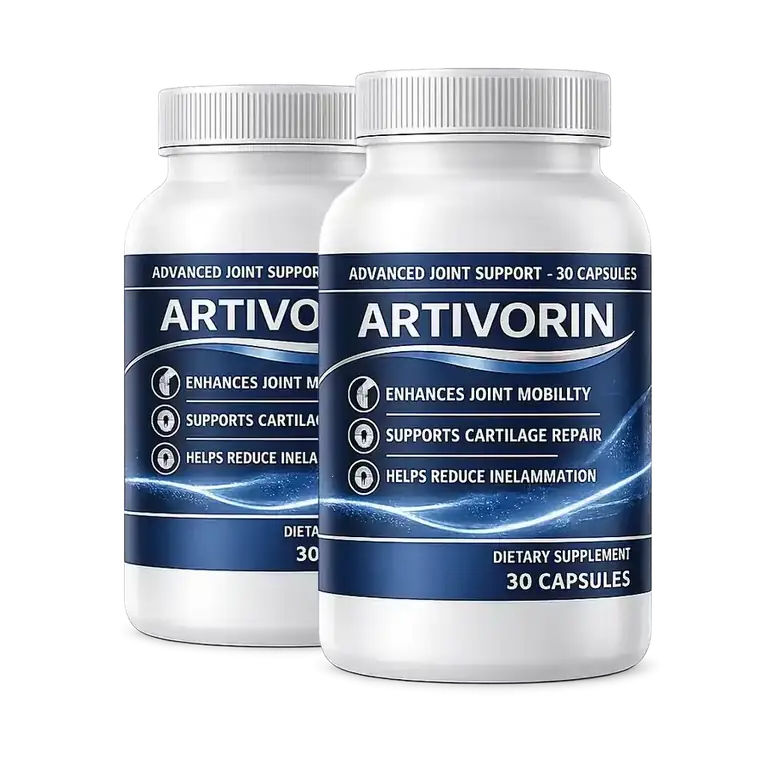
Artivorin names turmeric extract at 95 per cent curcuminoids
The grade is the research grade. The weight is not printed, on either of this product’s websites, and this desk says so on every page rather than estimating one. One capsule a day, 60 days from purchase in which to think again.
Two bottles $178 · six bottles $294 · 60-day money-back guarantee
Order Artivorin On The Official WebsiteLot ART-26/MY-2615 · one a day · 30 in every bottle
Why one capsule cannot hold the trial dose
This is worth doing explicitly, because it is the argument a buyer can make for themselves in a shop without reading a single study.
A size-0 capsule, the common one in this category, holds somewhere in the region of 400 to 600 mg of a dense botanical powder. A size-00, the larger one, holds roughly half as much again. Those are approximations and they vary with the density of the material, but they are the right order of magnitude.
The trial amount is 1,500 mg of curcuminoids, which is about 1,580 mg of a 95 per cent extract. That does not fit in one capsule of any size ordinarily used for supplements, and it is why the trials dosed three times a day: three capsules of around 500 mg get you there, one does not.
So a once-daily turmeric product, whatever it prints, is not delivering the trial amount. It may still be delivering a useful one. What it cannot be is the amount the trials established, and a label implying otherwise is relying on nobody doing this paragraph.
- A once-daily capsule cannot carry 1,500 mg of curcuminoids. The volume is not there.
- A three-times-daily product can, and a few research-grade products are packaged that way.
- A product using an enhanced-absorption formulation may reach useful blood levels at a lower weight, which is a real argument and belongs in its own article.
- A product printing no weight at all is asking you to take the whole question on trust.
Where curcumin sits against the rest of the category
A 2025 Bayesian network meta-analysis compared seven supplements against placebo in knee osteoarthritis across 39 randomised trials and 4,599 patients: eggshell membrane, vitamin D, Boswellia, curcumin, ginger, krill oil and collagen.
Boswellia came out highest for pain and stiffness, with improvements on the standard index and on the visual analogue scale. Curcumin, collagen, ginger and krill oil showed benefits on some outcomes, and the Bayesian rankings put krill oil and curcumin as the ones with potential for function specifically. No supplement was associated with more adverse events than placebo.
That is a more useful result than a league table looks. It says curcumin is genuinely in the group that does something, and it says it is not the top of that group, and a reader shopping for the best-evidenced ingredient rather than the most-marketed one should know both halves.
What to look for on a turmeric label
- A standardisation figure. 95 per cent curcuminoids is the research grade. A bottle saying only turmeric could be holding kitchen spice at two to five per cent.
- A printed weight beside it. Without one, the multiplication above cannot be done and the research cannot be connected to the product.
- An absorption partner, named. Piperine, a phospholipid complex or a nanoparticle system. Curcumin on its own absorbs poorly enough that this changes the answer.
- A dosing schedule that matches the amount. A once-daily product carrying a three-times-daily research amount is arithmetically impossible.
- A return window that covers eight weeks. Six for the ingredient, two for the decision.
Applied honestly, that list disqualifies a great deal of what is on sale, including some of it sold at premium prices. It also identifies the small number of products that have taken the research seriously, and those are usually easy to spot because they print everything and charge accordingly.
The one thing worth resisting is the assumption that a famous ingredient in a bottle is the same as the ingredient in the trial. It is the same compound. Whether it is the same amount is a different question, and it is the only question that decides whether the citations on the label are evidence or decoration.
References
- Panahi Y, Rahimnia AR, Sharafi M, et al. Curcuminoid treatment for knee osteoarthritis: a randomized double-blind placebo-controlled trial. Phytother Res. 2014;28(11):1625-31. PMID 24853120. Dose: 1,500 mg/day of curcuminoids in three divided doses for 6 weeks. https://pubmed.ncbi.nlm.nih.gov/24853120/
- Panahi Y, Alishiri GH, Parvin S, et al. Mitigation of systemic oxidative stress by curcuminoids in osteoarthritis: results of a randomized controlled trial. J Diet Suppl. 2016;13(2):209-20. PMID 25688638. https://pubmed.ncbi.nlm.nih.gov/25688638/
- Kuptniratsaikul V, Dajpratham P, Taechaarpornkul W, et al. Efficacy and safety of Curcuma domestica extracts compared with ibuprofen in patients with knee osteoarthritis: a multicenter study. Clin Interv Aging. 2014;9:451-8. PMID 24672232. Dose: 1,500 mg/day of Curcuma domestica extract against ibuprofen 1,200 mg/day for 4 weeks. https://pubmed.ncbi.nlm.nih.gov/24672232/
- Kuptniratsaikul V, Thanakhumtorn S, Chinswangwatanakul P, et al. Efficacy and safety of Curcuma domestica extracts in patients with knee osteoarthritis. J Altern Complement Med. 2009;15(8):891-7. PMID 19678780. Dose: 2 g/day of Curcuma domestica extract against ibuprofen 800 mg/day for 6 weeks. https://pubmed.ncbi.nlm.nih.gov/19678780/
- Bideshki MV, Jourabchi-Ghadim N, Radkhah N, et al. The efficacy of curcumin in relieving osteoarthritis: a meta-analysis of meta-analyses. Phytother Res. 2024;38(6):2875-2891. PMID 38576215. https://pubmed.ncbi.nlm.nih.gov/38576215/
- Zhang Y, Gui Y, Adams R, et al. Comparative effectiveness of nutritional supplements in the treatment of knee osteoarthritis: a network meta-analysis. Nutrients. 2025;17(15):2547. PMID 40806131. Thirty-nine randomised trials, 4,599 patients; Boswellia ranked first for pain and stiffness, curcumin among those showing benefit on some outcomes. https://pubmed.ncbi.nlm.nih.gov/40806131/
- Chen J, Zhou Q, Yu W, et al. A critical review of systematic reviews and meta-analyses of curcumin for knee osteoarthritis. Front Pharmacol. 2025;16:1664319. PMID 41560742. https://pubmed.ncbi.nlm.nih.gov/41560742/