Artivorin Official Website › Blog › Why Curcumin Absorption Decides Everything
Why Curcumin Absorption Decides Everything Else
After two grams of curcumin taken on its own, human serum levels in the classic study were undetectable or very low. Twenty milligrams of black pepper changed that sharply. Which means the milligram figure on a turmeric label is the second most important thing on it.
- Curcuminoids are poorly absorbed, rapidly metabolised and quickly cleared.
- In the 1998 study, 2 g of curcumin alone produced serum levels that were undetectable or very low in human volunteers.
- 20 mg of piperine, the pungent compound in black pepper, raised those levels sharply.
- Modern trial formulations solve this deliberately, with piperine, phospholipid complexes or particle-size engineering.
- The same enhancement that makes curcumin work may also matter to its safety record: three of the seven products tested in the turmeric liver-injury series contained piperine.
The absorption problem, in numbers
The study everybody cites was published in 1998 and it is worth knowing precisely rather than approximately. Human volunteers were given 2 g of curcumin. Serum concentrations afterwards were either undetectable or very low. The same 2 g given with 20 mg of piperine produced a sharp increase.
Two grams is a substantial amount of material, larger than the daily figure in most of the knee trials. The finding is therefore not that curcumin absorbs modestly. It is that swallowing a large quantity of it on its own can produce almost nothing measurable in the blood.
That single result reframes every turmeric label on every shelf. A weight on a panel is a statement about what went into the capsule, not about what reaches a joint, and for most compounds the two track each other closely enough that the distinction does not matter. For this one it matters more than anything else on the label.
Why the molecule behaves this way
Four properties combine, and none of them is fixable by taking more.
- It barely dissolves in water. A compound that will not dissolve in the gut cannot cross the gut wall in any quantity.
- It is metabolised rapidly in the intestinal wall and the liver. Much of what does get absorbed is conjugated into forms that leave quickly.
- It is cleared fast. Blood levels peak within a few hours and fall away, which is why the trials dosed three times a day rather than once.
- It is chemically unstable at the pH of the small intestine. Some of what arrives degrades before it can be absorbed at all.
Piperine works on the second of those, by inhibiting some of the enzymes that conjugate curcumin for excretion. Phospholipid and micelle systems work on the first, by presenting the molecule in a form that dissolves. Reducing particle size works on the first as well. Taking it with a fatty meal helps a little with the first and is free.
None of the approaches addresses all four, which is why the pharmacokinetics of curcumin remain modest even in the best formulations, and why a claim of enormously enhanced absorption should be read with the same care as any other superlative.
The five approaches a product can take
| Approach | What it does | What it costs |
|---|---|---|
| Piperine, from black pepper | The original and best-documented approach. 20 mg alongside curcumin raised human serum levels sharply in the 1998 study. | Piperine affects the metabolism of several medicines, and it appeared in three of the seven products tested in the turmeric liver-injury case series. |
| Phospholipid complexes | Binding curcuminoids to a lipid carrier so they cross the gut wall more readily. | More expensive material, and a lower curcuminoid percentage by weight because the carrier is part of the powder. |
| Nanoparticle and micelle systems | Reducing particle size or encapsulating in a micelle to improve dissolution. | Proprietary, expensive, and harder for a buyer to evaluate because the evidence is usually the manufacturer’s. |
| Taking it with a fatty meal | The free approach. Curcuminoids are fat-soluble and a meal containing oil helps. | Nothing, and it works to some degree with every formulation. |
| Nothing at all | Plain 95 per cent curcuminoid extract, swallowed alone. | The approach with the weakest pharmacokinetics, and the one a label naming no enhancer is describing. |
Five approaches. The last is the default, and it is what a label that names no absorption partner is implicitly using.
The fifth row is the default and it is more common than the first four combined, particularly among products sold on long web pages rather than through specialist retailers. A label naming no absorption partner is not doing anything wrong. It is telling you, by omission, which row it is on.
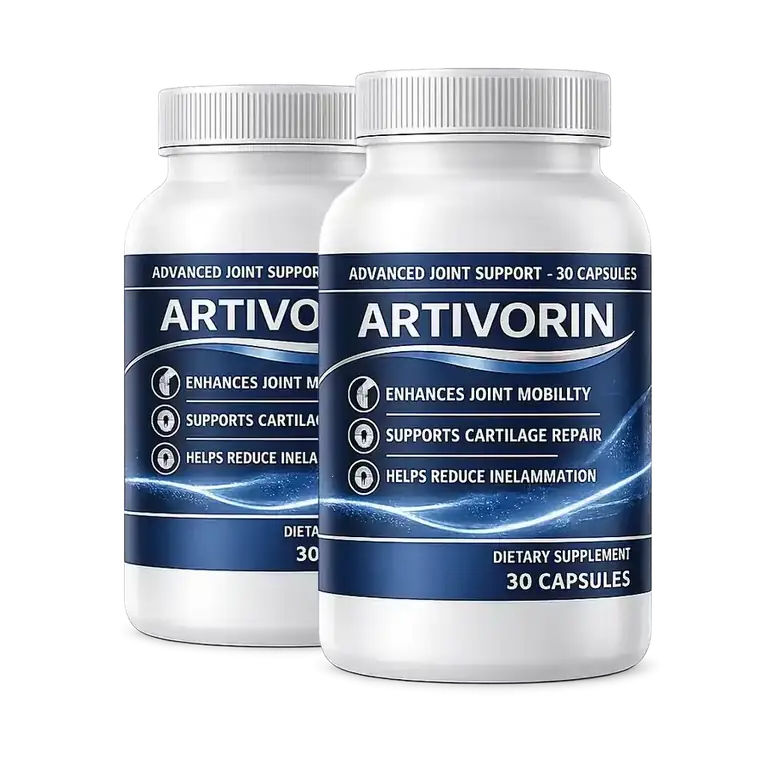
Four named ingredients, and no absorption partner among them
Artivorin names turmeric extract at 95 per cent curcuminoids, CoQ10, butcher’s broom and alpha-lipoic acid. None of the other three is an established curcuminoid enhancer. One capsule a day, with food, and a 60-day window running from the day you paid.
Two bottles $178 · six bottles $294 · 60-day money-back guarantee
Order Artivorin On The Official WebsiteLot ART-26/MY-2615 · one a day · 30 in every bottle
What the trials actually did about it
This is where the argument becomes practical rather than theoretical. The 2014 randomised knee trial used 1,500 mg a day of curcuminoids in three divided doses, which addresses the clearance problem directly: three peaks a day rather than one. The 367-patient comparison with ibuprofen used the same daily amount over four weeks.
The 2024 umbrella review of eleven meta-analyses pools trials that used a variety of preparations, and that variety is one of the reasons the underlying literature is as heterogeneous as it is. A trial of an enhanced formulation and a trial of plain extract are testing two different exposures, even at the same printed weight.
A Bayesian network meta-analysis of curcumin dosing has gone further and tried to model which amounts produce most of the effect, which is the right question and a difficult one precisely because the formulations differ.
The practical conclusion for a buyer is narrow and useful. A product delivering a three-times-daily schedule, or naming a specific absorption approach, is closer to what the trials did. A once-daily plain extract is further away, whatever weight it prints.
The uncomfortable half of the same story
An article arguing that better absorption is better would be incomplete without this, and it is the part that rarely appears in an absorption discussion.
The Drug-Induced Liver Injury Network published ten cases of liver injury associated with turmeric products, all enrolled since 2011 and six of them since 2017. Eight of the ten were women, the median age was 56, five people were admitted to hospital and one died of acute liver failure. Chemical analysis confirmed turmeric in all seven products that could be tested, and three of those seven also contained piperine.
The authors’ own conclusion names the possibility directly: that the apparent increase may reflect usage patterns or increased combination with black pepper. Seven of the ten patients carried a particular tissue type, HLA-B*35:01, at an allele frequency far above the population rate, which points at an individual susceptibility rather than a general toxicity.
Ten cases against the worldwide use of turmeric is a very small number, and it is not zero. The honest version of the absorption argument is therefore two-sided: the thing that makes curcumin more likely to work is plausibly also the thing that makes a rare reaction more likely, and anyone with existing liver disease should weigh that before choosing an enhanced formulation over a plain one.
Reading an absorption claim
| What a label says about absorption | How to read it |
|---|---|
| Names piperine or black pepper extract, with a weight | The clearest signal. It is the approach the original study used, and the weight lets you compare it with the 20 mg in that study. |
| Names a branded phospholipid or micelle system | A real approach. Look for the brand’s own published pharmacokinetic work, and read it knowing who funded it. |
| Says enhanced absorption with no mechanism named | A marketing phrase. It may be true and it cannot be checked. |
| Says nothing about absorption at all | The default. Assume plain extract, and assume the pharmacokinetics in the 1998 study. |
| Names an enhancer but prints no weight for anything | Better than silence and still unverifiable. You know the approach and not the scale. |
Five things a turmeric label can say, in descending order of how much they let you check.
- Find out which row the product is on. It takes ten seconds and it changes how you read every other number on the label.
- Prefer a named mechanism to an adjective. Enhanced, advanced and bioavailable are words. Piperine 20 mg is a fact.
- Take it with a fatty meal regardless. It helps every formulation and costs nothing.
- Do not stack an enhanced product with a plain one. The total becomes incalculable and the interaction profile doubles.
- If you take a medicine with a narrow margin, mention the piperine specifically. It affects the metabolism of several drugs, which is the same property that makes it useful here.
The point of this article is not that curcumin does not work. The evidence that it does something in knees is the strongest in the supplement category, and it was gathered at 1,500 mg a day in three divided doses.
The point is that the milligram figure alone never settled the question, and a buyer comparing two turmeric products on weight alone is comparing the wrong column. Absorption approach first, weight second, dosing schedule third. In that order, on any label, in any shop.
References
- Shoba G, Joy D, Joseph T, et al. Influence of piperine on the pharmacokinetics of curcumin in animals and human volunteers. Planta Med. 1998;64(4):353-6. PMID 9619120. After 2 g of curcumin alone, human serum levels were undetectable or very low; 20 mg of piperine alongside it raised them sharply. https://pubmed.ncbi.nlm.nih.gov/9619120/
- Panahi Y, Rahimnia AR, Sharafi M, et al. Curcuminoid treatment for knee osteoarthritis: a randomized double-blind placebo-controlled trial. Phytother Res. 2014;28(11):1625-31. PMID 24853120. Dose: 1,500 mg/day of curcuminoids in three divided doses for 6 weeks. https://pubmed.ncbi.nlm.nih.gov/24853120/
- Kuptniratsaikul V, Dajpratham P, Taechaarpornkul W, et al. Efficacy and safety of Curcuma domestica extracts compared with ibuprofen in patients with knee osteoarthritis: a multicenter study. Clin Interv Aging. 2014;9:451-8. PMID 24672232. Dose: 1,500 mg/day of Curcuma domestica extract against ibuprofen 1,200 mg/day for 4 weeks. https://pubmed.ncbi.nlm.nih.gov/24672232/
- Bideshki MV, Jourabchi-Ghadim N, Radkhah N, et al. The efficacy of curcumin in relieving osteoarthritis: a meta-analysis of meta-analyses. Phytother Res. 2024;38(6):2875-2891. PMID 38576215. https://pubmed.ncbi.nlm.nih.gov/38576215/
- Zhao J, Liang G, Zhou G, et al. Efficacy and safety of curcumin therapy for knee osteoarthritis: a Bayesian network meta-analysis. J Ethnopharmacol. 2024;321:117493. PMID 38036015. https://pubmed.ncbi.nlm.nih.gov/38036015/
- Halegoua-DeMarzio D, Navarro V, Ahmad J, et al. Liver injury associated with turmeric - a growing problem: ten cases from the Drug-Induced Liver Injury Network [DILIN]. Am J Med. 2023;136(2):200-206. PMID 36252717. https://pubmed.ncbi.nlm.nih.gov/36252717/