Artivorin Official Website › Blog › Do Joint Supplements Work?
Do Joint Supplements Work? 7 Checks Before You Buy One
People ask this in many ways: do they work, are they worth it, are they a scam, should I take one. The honest answer is that it depends on the ingredient, the amount and your expectations. These seven checks put the evidence in order.
Some joint supplement ingredients show modest gains in trials, especially curcumin and Boswellia for knee osteoarthritis. The rheumatology guideline leads with exercise and weight management, and it names just one supplement, with conditions. So they can help a little, none replaces exercise, and a label that prints no amounts is hard to judge.
- The 2019 guideline on hand, hip and knee osteoarthritis starts with exercise and weight loss. A single supplement, chondroitin sulphate, gets a conditional mention for hand osteoarthritis.
- A 2025 network meta-analysis compared seven supplements across 39 randomised trials and 4,599 patients, and Boswellia came top for pain and stiffness.
- In that analysis no supplement was linked to more adverse events than placebo.
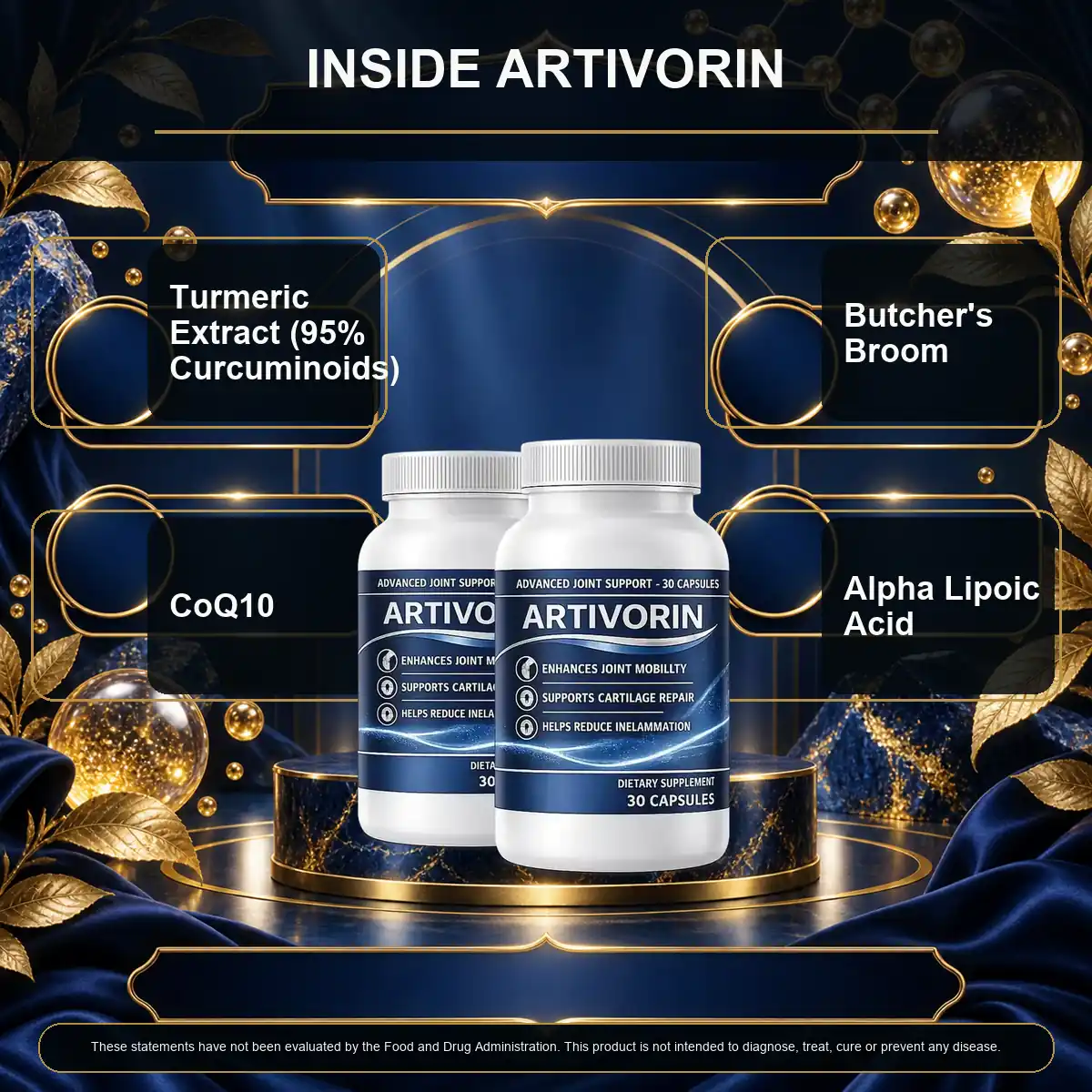
- The best-studied knee ingredient on the Artivorin label is turmeric extract, at 1,500 mg a day of curcuminoids in the trials.
- Joint supplements are dietary supplements. None is FDA approved, and no supplement is.
Check 1: What does the main guideline say?
Start with what clinicians are told to do. That 2019 guideline, from the American College of Rheumatology and the Arthritis Foundation, deals with hand, hip and knee osteoarthritis. Strong recommendations include exercise; weight loss for overweight people with knee or hip disease; self-management programmes; tai chi; a cane; bracing; hand orthoses for the thumb joint; topical and oral anti-inflammatories; and steroid injections into the knee.
Read that list again. One supplement appears in it: chondroitin sulphate, conditionally, for hand osteoarthritis. Nothing else from the supplement shelf is there at all.
That is not the same as saying supplements do nothing. A guideline sets a high bar for what clinicians should recommend. A supplement may show a real but modest and steady effect in trials and still fall short of that bar.
Check 2: What do the trials say about supplements?
The newest head-to-head is a 2025 Bayesian network meta-analysis in the journal Nutrients. The seven it set against placebo were eggshell membrane, vitamin D, Boswellia, curcumin, ginger, krill oil and collagen. In all, 39 randomised trials and 4,599 patients went into the pool.
| Result | What it found |
|---|---|
| Top for pain and stiffness | Boswellia, with gains on the standard osteoarthritis index |
| Some benefit on some outcomes | Curcumin, collagen, ginger and krill oil |
| Function | Krill oil and curcumin ranked well |
| Adverse events | No supplement was linked to more than placebo |
From the 2025 analysis as summarised on the seller’s joint supplement guide.
For curcumin the record is the most developed. A 2024 umbrella review of eleven meta-analyses reported steady gains in pain and function. A 2025 appraisal admits the trials vary and still finds a signal.
Check 3: How big is the effect, and how long does it take?
Modest, and slow. In knee osteoarthritis the curcumin trials found gains that were real statistically but modest clinically. Think stairs that get easier and mornings that get shorter, not a joint that stops registering.
Timing matters too. The shortest curcumin trial in knees that came out positive lasted six weeks. The dose in them was 1,500 mg of curcuminoids a day, taken as three portions. A person who judges any joint supplement at day ten is judging it inside the window where every trial reports nothing.
So the fair test is about eight weeks, with a few simple numbers written down first: minutes of morning stiffness, stairs without thinking, and days the joint decided something.
Check 4: Does the label print the amount?
If you run only one check, make it this one. The research uses specific weights, and a label that prints a weight beside an ingredient can be compared with the research in about ten seconds.
| Ingredient | Amount used in the research |
|---|---|
| Curcuminoids | 1,500 mg a day, in three divided doses, over six weeks |
| Whole turmeric extract | 2 g a day in an earlier pilot |
| Coenzyme Q10 | 300 to 400 mg a day for the strongest effect on inflammatory markers |
| Alpha lipoic acid | 600 mg a day, in diabetic nerve trials |
| Butcher’s broom | 150 mg of root extract per capsule, in vein trials |
| Glucosamine sulphate | 1,500 mg a day, the conventional research amount |
| Chondroitin sulphate | 800 to 1,200 mg a day |
From the joint supplement guide on this site. The first five rows come from trial abstracts. The last two are conventional research amounts.
Watch out for percentages. A percentage next to a weight acts as a divisor, so 10 mg of a 5 per cent extract holds half a milligram of the active part. Some labels count on nobody checking.
Check 5: Are joint supplements safe?
They are unusually well tolerated as a group, but the cautions that exist are specific, and mostly about medicines already in your cupboard.
- Turmeric and blood thinning: a dedicated study looked at a bioavailable curcumin product alongside antiplatelet agents, anticoagulants and thyroid replacement.
- Turmeric and the liver: ten cases linked to turmeric products were published. That is a very small number against huge use, and not zero.
- Alpha lipoic acid and blood sugar: it lowers glucose and has been linked to insulin autoimmune syndrome, including in people without diabetes.
- Glucosamine and shellfish: most glucosamine comes from shellfish, a point that affects a few people.
- Stacking: two products with the same ingredient turn a sensible amount into an unknown one.
- Surgery: stop anything studied alongside anticoagulants two weeks before, and tell the surgical team.
Tell your doctor what you take. For knees, hips and hands, a hot, swollen, locked or suddenly severe joint needs to be seen, not supplemented.
Check 6: How do you choose one?
Five steps, in order. They work on any shelf.
- Start with the free steps. Exercise and, where it applies, weight loss beat anything in a bottle.
- Choose one ingredient in one product. A blend with unstated amounts cannot be judged, and you cannot tell which part worked.
- Compare the weight with the research amount. For curcuminoids that is 1,500 mg a day.
- Allow eight weeks, after writing down three numbers.
- Buy from a seller who takes returns. Sixty days covers an eight-week test. Thirty days does not.
Applied to the bottle this site sells, the list gives a mixed answer. Its lead ingredient is the right one, its grade is the research grade, and its refund window fits a trial. The amounts are not printed, so step three cannot be done at all.
Check 7: Are they worth it for you?
Ask what you would do with the answer. If you are an adult with everyday stiffness, nothing alarming, a willingness to move and strengthen, and eight weeks to spare, a well-chosen supplement is a reasonable experiment. If you want fast relief, a painkiller does something else, and a supplement is the wrong shelf.
If you read panels, buy a product that prints its weights. If a joint has never been looked at, have it looked at once. A supplement is no substitute for an assessment.
Whichever you choose, write down your start line, keep the order email, and decide on a date. That turns a purchase into a test.
Frequently asked questions
Can joint supplements actually help?
Some ingredients show modest gains in trials, especially curcumin and Boswellia in knee osteoarthritis. The effect is slow and small, and none replaces exercise and weight management.
Are joint supplements worth it?
They can be a reasonable experiment for an adult with everyday stiffness who also moves and strengthens, and will test one for about eight weeks. They are not worth it as a replacement for exercise.
Are joint supplements safe?
As a group they are well tolerated, and no supplement in the 2025 comparison was linked to more adverse events than placebo. Specific cautions apply to blood thinners, the liver, blood sugar, shellfish and surgery.
What is the best joint supplement for knee pain?
No single winner exists. In the 2025 comparison Boswellia came first for pain and stiffness, and curcumin was among those helping on some outcomes. Pick one product that prints its weights.
How should I take joint supplements?
Follow the label, take it consistently, and judge it after about eight weeks. Do not stack two products with the same ingredient, and tell your doctor what you take.
Do joint supplements help arthritis?
A supplement is not a treatment for arthritis and does not replace a medicine that treats one. A joint that is hot, swollen or locked, or is suddenly worse, calls for a doctor.
Our view
Our view: joint supplements are a small, slow, mostly safe add-on, not a fix. The evidence is best for curcumin and Boswellia in the knee, and the guideline still puts movement and weight first. If you buy one, buy it for its weights and its refund route, not for its photographs.
The Artivorin label fits half of that. Its lead ingredient is the right one, and it prints no amounts. Whatever you pick, ask your doctor about any health question, and use the time before the refund window closes to decide with your own numbers.
Safety note. These statements have not been evaluated by the Food and Drug Administration. This product is not intended to diagnose, treat, cure or prevent any disease. Artivorin is a dietary supplement. It is not FDA approved, and no supplement is. Ask a doctor about any health question.
Last updated
Sources named on this website