Artivorin Official Website › Blog › How Does Artivorin Work?
How Does Artivorin Work? 5 Steps Through the Four Ingredients
A capsule with four ingredients has four stories about how it could work. They are not the same story. This walk-through takes them one at a time and marks the point where each runs out of evidence.
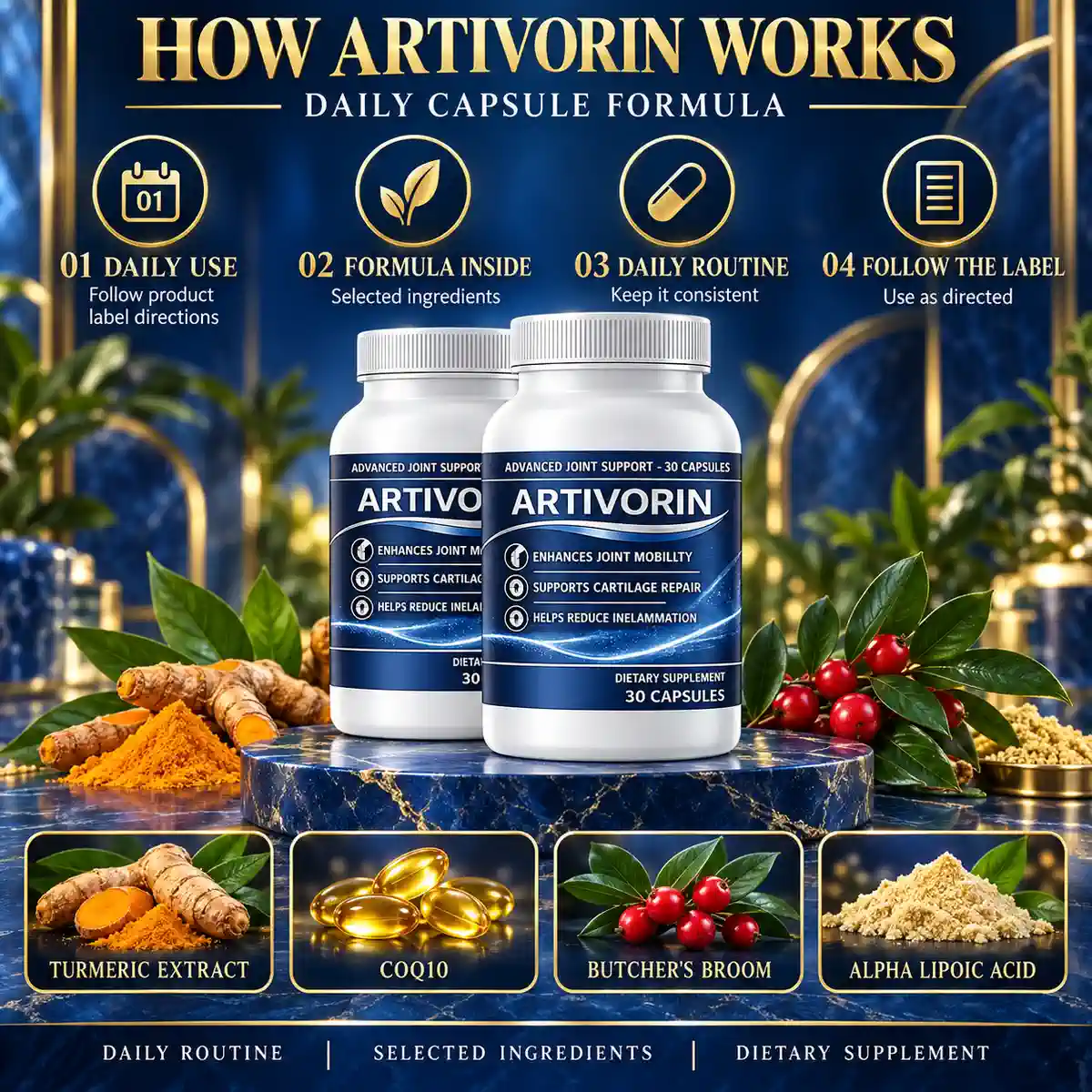
Artivorin rests on four separate ideas. Curcuminoids may quiet inflammatory signalling, CoQ10 supports cell energy, butcher’s broom tones vein walls and alpha lipoic acid recycles antioxidants. Only curcuminoids have joint trials behind them. A mechanism is an idea of how it might work, which is not the same as a result in a person.
- Four ingredients, four mechanisms. They share almost nothing except that all four are sold as supplements.
- Turmeric extract is the only one with randomised joint trials: 30 in osteoarthritis, at 1,500 mg a day of curcuminoids.
- For CoQ10, butcher’s broom and alpha lipoic acid, randomised osteoarthritis trials number zero.
- No trial has tested these four together, and no amount is printed on the label.
- Artivorin is a dietary supplement. It is not FDA approved, and no supplement is.
Step 1: What does “how it works” even mean for a supplement?
A mechanism is an account of how a substance might cause an effect. Labs can test it and it is useful, but it is not a result seen in people.
Three questions move you from a story to a claim, and they get harder in order. First, does it act on cells in a dish? Second, does it shift a blood marker in people? Third, do people feel or move any differently? Keep those three in mind. The table below applies them to each ingredient.
| Ingredient | Acts in lab work | Moves a marker in people | Changes joint symptoms |
|---|---|---|---|
| Turmeric extract | Yes, widely | Yes, in knee osteoarthritis trials | Yes. A 2024 review of eleven meta-analyses found reported gains in pain and function |
| Coenzyme Q10 | Yes | Yes, in inflammation and in muscle | No joint trial has been run |
| Butcher’s broom | Yes, on vein muscle | Yes, on leg volume | No joint trial has been run |
| Alpha lipoic acid | Yes | Yes, in inflammatory markers and nerve function | No joint trial has been run |
From the seller’s how-it-works page. The final column is what a buyer is really paying for.
Step 2: How might the turmeric extract work?
Turmeric is the lead ingredient, and the label gives it as an extract at 95% curcuminoids. That is the research grade used in the knee trials.
The idea is that an arthritic joint is not simply worn. The tissue around it makes signalling molecules that drive discomfort and some damage. Curcuminoids block several of the steps that turn those signals on. That is well shown in cell work.
In people, a 2025 review pooled randomised trials that measured blood markers of inflammation in knee osteoarthritis and found changes in them. On this label that is the nearest thing to a mechanism confirmed in people. It is still a blood test and not a joint scan.
The trials that reported results used 1,500 mg a day of curcuminoids. With no weight printed, nobody can say how much of that dose one capsule carries. Curcuminoids also absorb poorly alone, and the label names no helper such as black pepper extract.
Step 3: What about CoQ10, butcher’s broom and alpha lipoic acid?
The other three each have a real story, and none has been tested in a joint.
- CoQ10: a compound your own cells make, used in the part of the cell that turns food into energy. The supplement argument is that ageing tissue does this less well. Tested in people, it has gone furthest in muscle. A 2018 review found fewer statin-related muscle symptoms, and a 2020 analysis found none. Two careful reviews disagreeing is what a half-finished evidence base looks like.
- Butcher’s broom: its saponins act on the muscle in vein walls, so blood returns more efficiently and less fluid leaks out. In one placebo-controlled trial of 166 patients, the thing measured was leg volume. Applied to a joint, the idea would be better local circulation. It is not absurd, and nobody has tested it. The seller has not explained why it is on a joint label.
- Alpha lipoic acid: an antioxidant that recycles other antioxidants, and it works in both water and fat. Its famous trials, SYDNEY 2 and the four-year NATHAN 1, were in diabetic nerve damage at 600 mg a day.
Step 4: Does the whole capsule work as a team?
A formula can combine ingredients for three reasons. They hit the same target from different angles, one helps another absorb, or each has its own following and a longer list sells better. The first two are science. The third is commercial and fine as long as nothing is claimed for it.
Here only the first reason is open to argument. None of the other three is a known helper for curcuminoids, so the case is that four antioxidant and circulation ideas meet on a stiff joint from four sides. That is coherent. It is also untested as a combination.
Add up thirty curcumin trials, a handful of ruscus trials and two large alpha lipoic acid trials, and you have counted evidence for three separate products. Citations for the parts do not add up to proof for the whole.
Step 5: What does it do in a day, and what should you expect?
One capsule, swallowed. Nothing here is fast. You should not feel it within an hour the way you would feel caffeine or a painkiller.
Blood levels of curcuminoids climb within hours and fall away fast, which explains the three doses a day in the trials. Alpha lipoic acid clears within an hour. CoQ10 builds up slowly over weeks. One capsule a day is a trade-off between what the chemistry prefers and what people will stick with.
So plan in weeks. The seller’s review summary gives the usual wait as 3–6 weeks, and the shortest knee trial with a result lasted six weeks. Write down three simple numbers before the first capsule, then compare them later: minutes of morning stiffness, stairs without thinking, and days in the last seven that the joint decided something.
The curcumin trials reported gains that were real and modest. Think easier stairs and shorter mornings, not a joint that stops registering. Exercise and weight management head the rheumatology guideline. A capsule sits alongside.
Frequently asked questions
How does Artivorin work?
Through four proposed mechanisms: curcuminoids interfering with inflammatory signalling, CoQ10 supporting cell energy, butcher’s broom tightening vein walls and alpha lipoic acid recycling antioxidants. Only the first has joint trials.
Does it target the cause or only the symptoms?
Neither is shown for this capsule. The curcumin trials scored pain and function and took no cartilage images, so no structural claim can rest on them.
Has the finished Artivorin capsule been tested?
No. Each study cited here looked at one ingredient, usually at a dose the label does not print.
Why is a vein herb in a joint formula?
The seller has not explained it. The kind reading is better local circulation. No trial has tested that idea, so this site reports the ingredient and not the reason.
How quickly does it act once swallowed?
Curcuminoids peak within hours, alpha lipoic acid is gone within an hour and CoQ10 builds slowly over weeks. You feel none of that, which is why the timeline runs in weeks.
Do I need to take it forever?
Trials lasted from six weeks up to four years, and nobody was followed once they stopped. Nothing in the chemistry suggests a lasting change once you stop.
Our view
Our view: the mechanisms are real, and the label gives the names and nothing more. One of four ingredients has joint trials, and the amount that would link those trials to this capsule is not printed. Three quarters of the formula runs on argument, not on results.
That is a fair reason to be modest, not a reason to dismiss it. Treat the 60 days as a test with a way out, write your numbers down first, and ask a doctor about any joint problem that is hot, swollen or getting worse.
Safety note. These statements have not been evaluated by the Food and Drug Administration. This product is not intended to diagnose, treat, cure or prevent any disease. Artivorin is a dietary supplement. It is not FDA approved, and no supplement is. Ask a doctor about any health question.
Last updated
Sources named on this website
- The 2014 curcuminoid knee trial
- The 2025 review of inflammatory markers in knee osteoarthritis
- The 2018 meta-analysis of CoQ10 for statin myopathy
- The 166-patient placebo-controlled ruscus trial
- The SYDNEY 2 trial
- The four-year NATHAN 1 trial
- The American College of Rheumatology’s osteoarthritis guideline